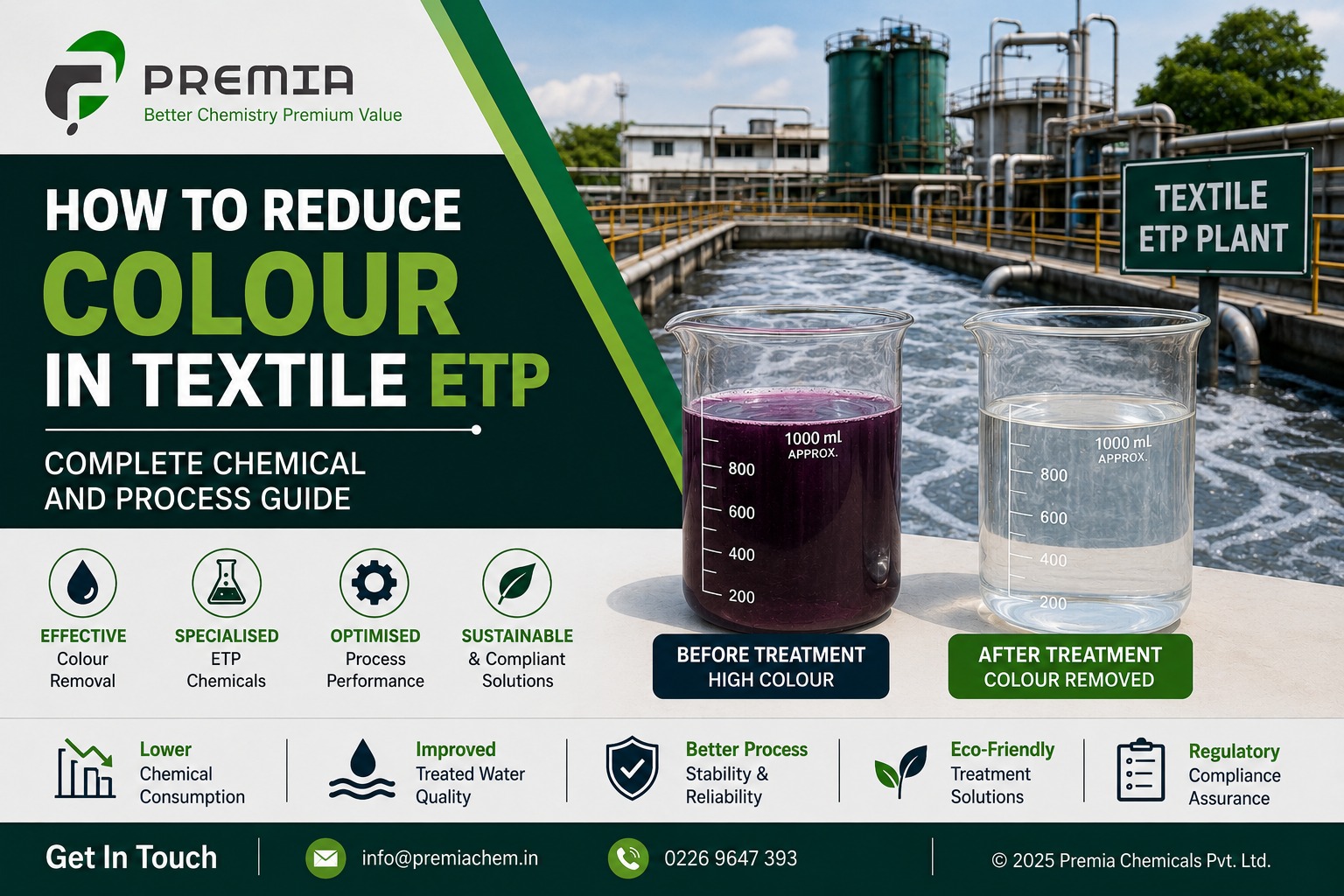
How to Reduce Colour in Textile ETP: Complete Chemical and Process Guide
Colour is one of the most visible and challenging parameters in textile wastewater treatment. A treated-water sample may show acceptable pH, suspended solids, BOD or COD, yet it can still appear dark, tinted or visibly coloured. This creates concerns regarding regulatory compliance, water reuse, RO operation, customer audits and the overall performance of the effluent treatment plant.
Textile wastewater colour is particularly difficult to manage because it does not originate from one standard source. It changes with the fibre being processed, dye class, shade depth, dyeing recipe, wash-off efficiency, production schedule and mixing of different process streams.
A textile ETP may receive:
- Reactive dyeing discharge from cotton processing
- Disperse dyeing discharge from polyester processing
- Soaping and wash-off liquor
- Printing wash water
- Scouring and bleaching discharge
- Silicone softener and finishing bath residues
- Reduction-clearing discharge
- Machine cleaning water
- Floor washing and concentrated chemical spillages
Consequently, colour removal should not be treated as a simple PAC-dosing operation. Reliable performance requires a coordinated combination of equalisation, pH correction, coagulation, specialised decolourisation, flocculation, clarification or flotation, biological treatment and tertiary polishing.
This guide explains the principal causes of textile wastewater colour, why conventional treatment frequently fails, how different ETP chemicals function and how textile units can optimise colour removal without creating unnecessary sludge or chemical cost.
Why Textile Effluent Contains Strong Colour
During textile dyeing, the complete quantity of dye applied to the bath does not become permanently fixed to the fibre. A portion remains unfixed or becomes hydrolysed and is subsequently discharged during rinsing, washing and soaping.
The quantity of colour entering the drain depends on several factors:
- Dye fixation efficiency
- Type and reactivity of dye
- Shade depth
- Salt and alkali concentration
- Liquor ratio
- Temperature profile
- pH control
- Washing sequence
- Soaping efficiency
- Fabric type
- Dyeing machine operation
Dark shades such as black, navy, maroon, bottle green, turquoise and royal blue generally create a stronger visible colour load than pale shades.
In reactive dyeing, hydrolysed reactive dye is especially difficult to remove because it remains water-soluble. In polyester dyeing, disperse dye particles may be accompanied by dispersing agents, levelling agents, reduction-clearing chemicals and oligomer contamination.
The ETP therefore receives a constantly changing mixture instead of a standard wastewater stream.
Major Sources of Colour in a Textile Processing Unit
Reactive Dyeing Discharge
Reactive dyes are widely used for cotton and cellulosic fibres. During dyeing, some dye reacts with the fibre while another portion reacts with water and becomes hydrolysed.
Hydrolysed reactive dye cannot fix to the fabric and is discharged during rinsing and soaping. Since it remains soluble, it may not settle effectively with PAC or alum alone.
Reactive dyeing effluent commonly contains:
- Hydrolysed reactive dye
- Sodium chloride or sodium sulphate
- Soda ash
- Caustic soda
- Wetting agents
- Sequestering agents
- Levelling agents
- Soaping agents
- Dispersing chemicals
The combination of strong colour, high salinity and variable alkalinity makes this stream particularly challenging.
Soaping and Washing Discharge
The objective of soaping is to remove unfixed and hydrolysed dye from the fabric. Therefore, soaping discharge can be intensely coloured even when the fabric result is excellent.
This stream may also contain:
- Surfactants
- Dispersants
- Chelating agents
- Alkali
- High-temperature degradation products
- Suspended lint
Sudden discharge of concentrated soaping liquor can create a major shock in the ETP.
Polyester Dyeing Discharge
Disperse dyes are used for polyester dyeing. Although these dyes are not as water-soluble as reactive dyes, they are used with dispersing agents that help keep fine dye particles suspended.
Polyester wastewater may contain:
- Disperse dye particles
- Dispersing agents
- Levelling agents
- Acetic acid
- Carriers, where used
- Reduction-clearing residues
- Sodium hydrosulphite residues
- Caustic residues
- Polyester oligomers
Some of these substances interfere with floc formation and biological treatment.
Printing Wash Water
Textile printing operations can generate high-strength wastewater from:
- Screen washing
- Blanket washing
- Colour kitchen cleaning
- Printing paste residue
- Pigment binder residue
- Thickener residue
- Urea-containing wash water
- Reactive or disperse printing dyes
Printing wastewater is often inconsistent and can have very high colour and COD.
Finishing Section Discharge
Finishing chemicals can destabilise ETP performance when concentrated quantities enter the treatment plant.
Potential contaminants include:
- Silicone softeners
- Cationic softeners
- Polyethylene wax emulsions
- Resins
- Acrylic binders
- Antistatic agents
- Hydrophilic finishes
- Water repellents
- Oils and lubricants
Some finishing emulsions form stable colloidal systems that do not settle easily with ordinary treatment.
Why Colour Removal Frequently Fails
Poor Equalisation
Equalisation is the foundation of stable textile wastewater treatment.
If concentrated dark-shade discharge reaches chemical treatment directly, the chemical dosage that worked thirty minutes earlier may become completely inadequate. Operators then increase dosing without understanding the actual load.
A properly designed and mixed equalisation tank helps stabilise:
- Flow
- Temperature
- pH
- Colour
- COD
- Suspended solids
- Salinity
Equalisation does not remove pollution, but it makes the pollution treatable.
The tank should be mixed continuously using air or mechanical agitation. Dead zones and settled solids must be avoided.
Incorrect pH
Coagulation and decolourisation performance depend strongly on pH.
Textile effluent can be highly alkaline because of:
- Caustic scouring
- Reactive dyeing alkali
- Soda ash
- Reduction clearing
- Cleaning chemicals
A chemical that performs well at pH 7 may perform poorly at pH 10.5.
The optimum pH depends on:
- Coagulant chemistry
- Decolourant chemistry
- Dye class
- Alkalinity
- Suspended solids
- Biological-treatment requirement
The pH should therefore be established through a jar test rather than assumption.
Dependence on PAC or Alum Alone
PAC and alum are useful coagulants, but they are not universal textile decolourants.
They are generally more effective against:
- Suspended particles
- Colloidal matter
- Turbidity
- Some dispersed colour
- Fine solids
However, soluble anionic dye molecules may remain in the treated water.
When a plant keeps increasing PAC dosage but colour remains, the problem may not be insufficient PAC. The process may require a specialised cationic decolourant.
Incorrect Chemical Sequence
Dosing all chemicals at one point can reduce their efficiency.
A typical sequence may involve:
- pH correction
- Coagulant dosing
- Specialised decolourant dosing
- Controlled flocculant dosing
- Slow floc growth
- Settling or flotation
The exact sequence should be verified by trial. However, sufficient contact time must be provided between the major stages.
Inadequate Flash Mixing
Coagulants and decolourants require rapid distribution throughout the wastewater.
If mixing is insufficient:
- Chemical remains localised
- Dye–polymer contact is poor
- Floc formation becomes uneven
- Chemical consumption rises
- Outlet performance fluctuates
If mixing is excessively harsh for too long, developing flocs may break.
Poor Flocculation
After destabilisation, smaller particles must combine into larger flocs.
Flocculation requires:
- Correct polymer type
- Correct polymer dilution
- Adequate maturation time
- Low and controlled dosage
- Gentle mixing
- Sufficient retention time
Overdosing flocculant can create slippery, floating or weak sludge. Underdosing can lead to fine carryover.
Clarifier or DAF Overloading
Even when the chemistry is correct, separation can fail because of hydraulic or solids overloading.
Warning signs include:
- Floc visible in outlet water
- Rising sludge blanket
- Turbid overflow
- Floating sludge
- Short-circuiting
- Excessive surface loading
- Poor sludge withdrawal
The clarifier, tube settler or DAF must be evaluated as part of the complete system.
Recommended Treatment Sequence for Textile Colour Removal
1. Screening
Screens remove lint, yarn, fabric pieces and larger suspended contaminants.
Suitable screening can include:
- Manual bar screens
- Fine screens
- Rotary drum screens
- Wedge-wire screens
Effective screening protects pumps, pipelines, agitators and downstream equipment.
2. Equalisation
The wastewater should be homogenised before chemical treatment.
The equalisation tank should provide:
- Adequate holding capacity
- Continuous mixing
- Minimal dead zones
- Stable pumping
- pH monitoring
- Controlled transfer to chemical treatment
Highly concentrated streams should preferably be discharged gradually rather than released as one batch.
3. Cooling Where Necessary
High-temperature wastewater can affect:
- Chemical reaction
- Polymer performance
- Biological activity
- Dissolved oxygen
- Membrane performance
The temperature should be controlled before biological treatment and, where necessary, before chemical treatment.
4. pH Correction
Acid or alkali is added to bring the wastewater into the selected treatment window.
The target pH must be finalised through jar testing.
Common correction chemicals may include:
- Sulphuric acid
- Hydrochloric acid
- Carbon dioxide
- Caustic soda
- Lime
Chemical selection should consider safety, corrosion, sludge generation, control accuracy and operating cost.
5. Coagulation
Coagulants destabilise colloids and suspended particles.
Common options include:
- Poly aluminium chloride
- Alum
- Ferric chloride
- Ferric sulphate
- Specialised blended coagulants
The best coagulant should be selected based on actual wastewater rather than price per kilogram.
6. Decolourant Dosing
A dedicated textile-effluent decolourant is used where soluble or difficult colour remains after conventional coagulation.
Many textile decolourants are cationic polymers that interact with anionic dye molecules. They help form complexes that can be separated through clarification or flotation.
The optimum dose is influenced by:
- Dye concentration
- Dye class
- Wastewater pH
- Salt concentration
- COD
- Coagulant dosage
- Mixing condition
Overdosing should be avoided because it may increase cost, sludge load and residual cationic demand.
7. Flocculation
A suitable flocculant helps create larger, stronger and rapidly settling flocs.
Flocculants may be:
- Anionic
- Cationic
- Non-ionic
- Low, medium or high molecular weight
Selection depends on the charge and characteristics of the chemically treated solids.
8. Clarification or DAF
The generated solids must be separated from the treated water.
A clarifier or tube settler is suitable for dense, settleable flocs.
DAF may be more appropriate when wastewater contains:
- Oil and grease
- Silicone emulsions
- Light flocs
- Floating solids
- Fine dispersed contamination
The separation system must be matched with the chemical program.
9. Biological Treatment
Biological treatment primarily reduces biodegradable BOD and COD. It may reduce some colour, but many synthetic dyes resist conventional biodegradation.
Common systems include:
- Activated sludge process
- MBBR
- MBR
- SBR
- Hybrid biological systems
The biological stage performs better when colour, toxicity, oil and excess suspended solids have been reduced upstream.
10. Tertiary Polishing
Residual turbidity, colour and organics can be polished using:
- Pressure sand filtration
- Activated carbon filtration
- Ultrafiltration
- Ozonation
- Advanced oxidation
- Micron filtration
The tertiary system should not be forced to compensate for weak primary treatment.
11. RO and ZLD Pretreatment
For water-reuse and ZLD systems, colour removal must be combined with control of:
- Hardness
- Silica
- Suspended solids
- Oil and grease
- COD
- SDI
- Microbiological growth
- Scaling ions
Visually clear water is not necessarily membrane-safe water. RO feed must be evaluated through appropriate analytical parameters.
Coagulant, Decolourant and Flocculant: Key Differences
Coagulant
A coagulant destabilises suspended and colloidal contaminants.
Its principal role is to reduce:
- Turbidity
- Fine solids
- Colloidal stability
- A portion of colour
- Some organic matter
Examples include PAC, alum and ferric salts.
Decolourant
A decolourant is designed specifically to interact with dye molecules and coloured organic contaminants.
Its principal role is to reduce:
- Soluble colour
- Reactive dye colour
- Difficult anionic colour
- Residual colour after conventional coagulation
A decolourant should not automatically be treated as a substitute for all coagulants. In many applications, a balanced combination performs better.
Flocculant
A flocculant bridges destabilised particles and helps produce larger flocs.
Its principal role is to improve:
- Settling rate
- Floc size
- Clarifier performance
- DAF separation
- Sludge dewatering
Each chemical has a different function. Increasing one chemical cannot always compensate for the absence or incorrect use of another.
Practical Jar Test Method
A jar test is the most reliable starting point for optimising textile colour removal.
Sample Collection
Collect a representative sample from the equalisation tank after proper mixing.
Avoid collecting:
- Only the top layer
- Settled bottom sludge
- A one-time concentrated drain sample
- A sample immediately after chemical spillage
Record:
- Sample time
- Production shade
- Fabric type
- Process running
- pH
- Temperature
- Visual colour
- COD, where available
- TSS, where available
Test Procedure
Take equal quantities of wastewater in multiple beakers, preferably one litre each.
Step 1: pH Screening
Adjust different beakers to selected pH levels.
For example:
- Beaker 1: original pH
- Beaker 2: pH 6.5
- Beaker 3: pH 7.0
- Beaker 4: pH 7.5
- Beaker 5: pH 8.0
The exact range should reflect the plant chemistry.
Step 2: Coagulant Screening
Add different coagulant dosages while keeping other parameters constant.
Rapidly mix for approximately one to two minutes.
Step 3: Decolourant Screening
Add the selected decolourant at different dosages.
Provide adequate rapid contact without prolonged high-shear mixing.
Step 4: Flocculant Addition
Add a properly prepared and diluted flocculant solution at low dosage.
Continue gentle mixing to develop flocs.
Step 5: Settling
Allow the samples to settle without disturbance.
Observe after:
- 5 minutes
- 10 minutes
- 20 minutes
- 30 minutes
Evaluation Parameters
The best result should be selected based on:
- Residual colour
- Supernatant clarity
- Floc size
- Settling speed
- Sludge volume
- Floating matter
- Turbidity
- Chemical cost
- pH after treatment
- Downstream compatibility
The clearest beaker is not always the most economical or operationally stable solution.
Why Overdosing Chemicals Is Not a Sustainable Solution
When colour increases, operators often increase PAC, alum or polymer dosing without conducting a jar test.
This can create:
- Excessive sludge
- Increased sludge-disposal cost
- High dissolved aluminium or iron
- Higher chloride or sulphate load
- Poor floc structure
- Polymer carryover
- Higher COD contribution
- Biological inhibition
- RO fouling
- Increased treatment cost
The correct objective is not maximum dosage. It is the lowest stable dosage that consistently meets the required outlet quality.
How to Reduce Chemical Cost per Kilolitre
Improve Equalisation
Stable inlet quality reduces safety-factor overdosing.
Separate Concentrated Streams
Highly coloured first washes, printing paste washings or chemical spillages may be managed separately or released gradually.
Optimise pH
A small correction in pH may reduce coagulant and decolourant demand substantially.
Calibrate Dosing Pumps
The indicated pump setting may not match the actual flow.
Check actual output using:
- Measuring cylinder
- Timed collection
- Stroke verification
- Solution concentration
- Pump-maintenance status
Standardise Chemical Dilution
Operators should follow controlled preparation procedures.
Record:
- Product quantity
- Water quantity
- Mixing time
- Maturation time
- Solution age
Monitor Cost per Kilolitre
Do not compare products only by price per kilogram.
Calculate:
Treatment cost per KL = Chemical dosage in kg/KL × Chemical price per kg
Also consider:
- Sludge production
- Labour
- Filter-press operation
- Disposal cost
- RO cleaning
- Downtime
- Outlet compliance
A higher-priced but lower-dose product may be more economical overall.
Colour Removal in Reactive Dyeing Effluent
Reactive dye wastewater often requires a combined program because hydrolysed dye remains soluble.
Performance can improve through:
- Strong equalisation
- Controlled pH
- Dedicated cationic decolourant
- Correct coagulant support
- Low-dose optimised flocculant
- Proper clarifier or DAF operation
- Controlled release of soaping discharge
Dark reactive shades should be considered shock loads rather than treated as normal average wastewater.
Colour Removal in Polyester Dyeing Effluent
Polyester effluent presents a different treatment challenge.
The program may need to focus on:
- Fine disperse-dye particles
- Dispersing agents
- Oils and oligomers
- Reduction-clearing load
- Floating and emulsified contamination
DAF can be useful where solids are light or where oil and emulsion loading is significant.
The chemical program should be tested for both colour removal and biological compatibility.
Role of DAF in Textile Effluent Treatment
DAF uses fine air bubbles to lift chemically conditioned contaminants to the surface.
It can be effective for:
- Oil and grease
- Silicone emulsion
- Fine suspended matter
- Low-density flocs
- Floating contamination
- Certain coloured complexes
However, DAF does not correct poor chemistry.
Its performance depends on:
- pH
- Coagulant dose
- Decolourant dose
- Polymer dose
- Floc quality
- Recycle ratio
- Saturation pressure
- Air release
- Hydraulic loading
- Scraper operation
Chemical and mechanical optimisation must be carried out together.
Role of Biological Treatment in Colour Reduction
Biological treatment is essential for BOD and biodegradable COD reduction, but it should not be expected to remove all synthetic colour.
The biomass may become unstable due to:
- Sudden pH shock
- High salinity
- Toxic dye intermediates
- Excess oxidising or reducing chemicals
- Oil and silicone loading
- High temperature
- Nutrient imbalance
- Excess chemical carryover
Proper primary treatment protects the biological stage and improves overall ETP reliability.
Final Colour Polishing
After chemical and biological treatment, residual colour may be polished through:
Activated Carbon
Activated carbon adsorbs residual colour and organic contaminants. However, it becomes expensive if upstream colour removal is poor.
Ozone
Ozone can oxidise coloured molecules and may improve colour reduction. Its economics and treatment effectiveness depend on wastewater quality.
Advanced Oxidation
Advanced oxidation processes may use combinations involving:
- Ozone
- Hydrogen peroxide
- UV
- Fenton chemistry
These processes should be evaluated based on actual wastewater and downstream objectives.
Ultrafiltration
UF removes fine suspended matter and macromolecular contamination but does not necessarily remove all dissolved colour.
Reverse Osmosis
RO can separate dissolved salts and colour-forming substances, but poor pretreatment will lead to rapid fouling.
Common Operational Checks When Colour Removal Deteriorates
When the final outlet becomes coloured, check the system systematically.
Inlet and Equalisation
- Has the shade mix changed?
- Was a dark-shade bath discharged suddenly?
- Is the equalisation mixer operational?
- Is the tank level unusually low?
- Has concentrated printing or soaping discharge entered?
pH Control
- Is the online pH meter calibrated?
- Is acid or alkali dosing functioning?
- Is the actual pH matching the display?
- Has wastewater alkalinity changed?
Chemical Preparation
- Was the correct chemical used?
- Was the solution prepared at the correct concentration?
- Has polymer solution become too old?
- Are dosing pumps delivering actual output?
- Are chemical drums empty or blocked?
Mixing and Flocculation
- Is the flash mixer functioning?
- Is flocculator speed appropriate?
- Is sufficient retention time available?
- Are flocs forming and then breaking?
Clarifier or DAF
- Is sludge being withdrawn regularly?
- Is the clarifier overloaded?
- Is the DAF recycle system functioning?
- Is there floc carryover?
- Is sludge floating?
Biological Treatment
- Is MLSS healthy?
- Is dissolved oxygen adequate?
- Has biomass colour changed?
- Is foaming excessive?
- Is sludge settling correctly?
Tertiary Treatment
- Is the sand filter backwashed?
- Is activated carbon exhausted?
- Are filters bypassing?
- Is UF operating within design pressure?
- Has RO feed SDI increased?
How Premia Chemicals Approaches Textile ETP Colour Removal
Premia Chemicals Pvt. Ltd. develops application-specific chemical programs for textile processing wastewater.
The technical approach may include:
- Review of process and ETP flow
- Representative sample collection
- pH screening
- Coagulant evaluation
- Decolourant evaluation
- Flocculant selection
- Sludge-volume comparison
- Clarifier or DAF compatibility
- Plant-scale dosing trial
- Cost-per-KL calculation
- RO and ZLD compatibility assessment
- Operator dosing guidance
The purpose of the program is not merely to make one laboratory beaker look clear. The objective is to achieve stable plant performance under changing production conditions.
Information Required for a Technical Evaluation
For a preliminary assessment, the following information is useful:
- Daily ETP flow
- Equalisation-tank capacity
- Textile process type
- Fibre processed
- Dye classes used
- Typical pH
- COD
- BOD
- TSS
- TDS
- Hardness
- Current chemicals and dosages
- Existing treatment sequence
- Clarifier or DAF details
- Biological system type
- RO or ZLD requirement
- Present sludge generation
- Current treatment cost
A representative wastewater sample is normally required before finalising a chemical recommendation.
Frequently Asked Questions
Which chemical is best for colour removal in textile ETP?
There is no single chemical that performs best in every textile ETP. Selection depends on dye class, pH, COD, TSS, salt, process chemicals and the existing ETP configuration. A combination of coagulant, dedicated decolourant and flocculant is often more effective than using PAC or alum alone.
Why does colour remain even after increasing PAC dosage?
PAC is primarily a coagulant. It can reduce suspended matter, turbidity and some colour, but soluble reactive-dye molecules may require a specialised cationic decolourant. Incorrect pH and poor mixing can also limit PAC performance.
Can alum completely remove reactive dye colour?
Alum may remove a portion of colour, especially where colour is associated with suspended or colloidal matter. However, highly soluble hydrolysed reactive dyes often require supplementary decolourisation chemistry.
Does a higher chemical dosage always improve colour removal?
No. Overdosing can reverse charge, weaken flocs, increase sludge, raise treatment cost and affect downstream biological or membrane systems. Dosage should be established through jar testing.
Can biological treatment remove all textile colour?
Biological treatment may reduce some biodegradable colour-producing compounds, but many synthetic dyes resist conventional biodegradation. Primary chemical treatment and tertiary polishing may therefore be required.
Is DAF better than a clarifier?
Neither is universally better. Clarifiers work well for dense settleable flocs. DAF can perform better for low-density flocs, oil, silicone emulsions and floating contamination. Selection depends on wastewater characteristics and plant design.
Why does colour-removal performance change every day?
Textile wastewater changes according to shade, dye type, fabric, production sequence, washing process, chemical use, salt, alkali and discharge timing. Equalisation and regular jar testing are required to manage this variation.
How can sludge generation be reduced?
Sludge can be reduced through pH optimisation, correct chemical selection, lower inorganic-coagulant dependence, controlled polymer dosing, improved equalisation and avoiding unnecessary overdosing.
Is clear treated water automatically suitable for RO?
No. RO feed must also be checked for SDI, turbidity, hardness, silica, COD, oil and grease, microorganisms and scaling potential. Visual clarity alone is insufficient.
How should a textile unit select an ETP decolourant?
The product should be compared through jar testing and a controlled plant trial. Evaluation should include colour removal, dosage, sludge quantity, settling, pH requirement, biological compatibility, RO compatibility and total cost per kilolitre.
Conclusion
Reliable colour removal in a textile ETP requires more than increasing PAC or polymer dosage. The complete treatment system must be considered, starting from process discharge and equalisation and continuing through pH correction, coagulation, decolourisation, flocculation, solids separation, biological treatment and tertiary polishing.
The right solution is the one that delivers:
- Consistent outlet colour
- Stable floc formation
- Controlled sludge generation
- Reliable biological performance
- Improved RO and ZLD protection
- Lowest practical treatment cost per kilolitre
Premia Chemicals Pvt. Ltd. supports textile processing units with wastewater evaluation, jar testing, plant trials and application-specific ETP chemical programs.
To evaluate colour removal in your textile ETP, share your process details and a representative equalisation-tank sample with the Premia Chemicals technical team.