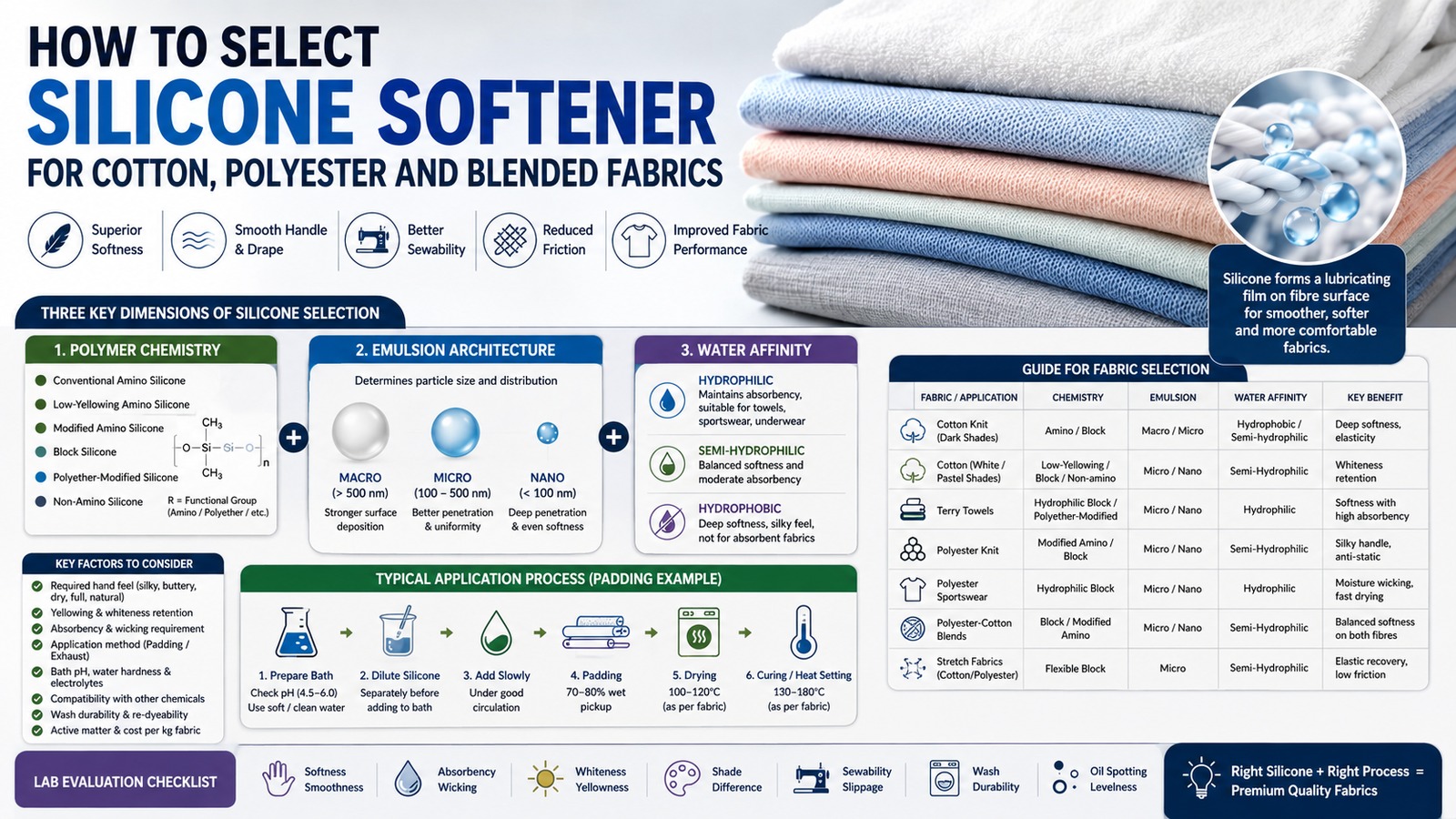
How to Select Silicone Softener for Cotton, Polyester and Blended Fabrics
Silicone softeners are among the most important finishing auxiliaries used to improve the commercial handle, smoothness, sewability, drape and surface characteristics of textile fabrics.
However, selecting a silicone softener is not as simple as choosing between “amino,” “block,” “micro,” “macro,” “nano,” “hydrophilic” or “hydrophobic.”
These terms describe different technical dimensions.
- Amino and block describe the chemistry or polymer architecture.
- Macro, micro and nano describe the emulsion or particle-size architecture.
- Hydrophilic and hydrophobic describe the functional behaviour of the finish toward water.
- Cationic and non-ionic describe the ionic character of the formulated product.
A silicone softener can therefore be:
- An amino silicone macroemulsion
- An amino silicone microemulsion
- A hydrophilic block silicone microemulsion
- A hydrophobic amino silicone nanoemulsion
- A non-ionic polyether-modified silicone
- A low-yellowing block silicone
These descriptions are not mutually exclusive.
The correct silicone-softener selection depends on:
- Fibre composition
- Fabric construction
- Required hand feel
- Shade and whiteness sensitivity
- Water absorbency requirement
- Drying and curing temperature
- Application by padding or exhaustion
- Water hardness
- Bath pH
- Electrolyte concentration
- Compatibility with other finishing chemicals
- Washing-durability requirement
- Reprocessing requirement
- Final cost per kilogram of fabric
The objective is not to select the product that gives the maximum softness in one laboratory trial.
The correct product must provide the required commercial handle while avoiding:
- Yellowing
- Shade change
- Loss of absorbency
- Oil spots
- Uneven deposition
- Roller build-up
- Bath separation
- Fabric slippage
- Excessive hydrophobicity
- Poor wash durability
- Re-dyeing difficulties
- High finishing cost
This guide explains how amino, block, macro, micro, nano, hydrophilic and hydrophobic silicone systems should be evaluated for cotton, polyester and blended fabrics.
First Principle: Do Not Compare Unlike Categories
A common technical mistake is to ask:
Is block silicone better than micro silicone?
This comparison is incomplete.
A block silicone describes a polymer structure, whereas a microemulsion describes the physical form in which the polymer is delivered.
Similarly:
Is amino silicone better than hydrophilic silicone?
An amino silicone can itself be modified to provide partial hydrophilicity, while certain block silicones may contain amino and polyether segments.
The selection process should be divided into three levels.
Level 1: Select the Polymer Chemistry
Choose between:
- Conventional amino silicone
- Modified amino silicone
- Low-yellowing amino silicone
- Block silicone
- Polyether-modified silicone
- Non-amino silicone
- Other specialised functional silicones
Level 2: Select the Emulsion Architecture
Choose between:
- Macroemulsion
- Microemulsion
- Nanoemulsion
Level 3: Select the Required Water Behaviour
Choose between:
- Hydrophilic
- Semi-hydrophilic
- Hydrophobic
Only after these three decisions should dosage, ionic character, application method and compatibility be finalised.
How Silicone Softeners Work
Textile pretreatment, bleaching, dyeing, washing and drying can remove natural lubricating materials from fibres and increase friction between fibres, yarns and fabric surfaces.
Silicone polymers have a flexible siloxane backbone and low surface energy. When applied correctly, they form a lubricating layer over or within the textile structure.
This can improve:
- Surface smoothness
- Inner softness
- Fibre-to-fibre movement
- Yarn mobility
- Sewability
- Tear strength
- Elastic recovery
- Drape
- Crease recovery
- Abrasion behaviour
- Resistance to fibre breakage
- Perceived fabric quality
The final result depends on:
- Polymer functionality
- Molecular weight
- Amino content
- Polymer architecture
- Emulsion particle size
- Degree of fibre penetration
- Degree of surface deposition
- Drying and curing conditions
- Fabric construction
A silicone with a strong surface deposit may provide a silky or slick handle. A finer and more penetrating system may provide internal softness with a cleaner surface feel.
Part 1: Silicone Polymer Chemistry
Conventional Amino Silicone
Amino silicone is one of the most widely used silicone-softener categories in textile finishing.
It contains amino-functional groups attached to a polysiloxane backbone. Under mildly acidic conditions, the amino groups can become cationic and develop affinity for negatively charged textile surfaces, especially cellulosic fibres.
Typical Handle
- Deep softness
- Silky smoothness
- Rich surface lubrication
- Elastic handle
- Improved sewability
- Full and commercial feel
Suitable Applications
- Dark cotton knits
- Cotton hosiery
- Viscose
- Cotton-viscose blends
- Polyester fleece
- Dark polyester knits
- Fabrics where absorbency is not critical
Main Advantages
- Strong softness
- Good fibre lubrication
- Good exhaustion on cotton
- Improved elasticity
- Improved sewability
- Durable handle
- Strong commercial effect at controlled dosage
Main Limitations
- Yellowing on white or pastel shades
- Reduced absorbency
- Increased hydrophobicity
- Shade deepening
- Possible oil spots
- Difficult removal before re-dyeing
- Sensitivity to incompatible anionic chemicals
- Potential instability under high electrolyte, pH or shear conditions
Conventional amino silicone tends to orient on the fibre and form a low-energy surface that provides excellent softness but can reduce moisture uptake. Traditional amino silicones are also associated with yellowing and emulsion-stability problems under demanding processing conditions.
Low-Yellowing Amino Silicone
Low-yellowing amino silicone is designed to retain much of the softness of conventional amino silicone while reducing heat-related or storage-related discolouration.
This may be achieved through:
- Modified amino functionality
- Lower reactive-amino content
- Sterically hindered amino groups
- Controlled amino value
- Alternative polymer architecture
- Improved antioxidant or emulsion design
Suitable Applications
- Pale shades
- Pastel shades
- Light cotton knits
- Polyester-cotton blends
- Fabrics exposed to moderate heat
- White goods where very high whiteness is not mandatory
Important Limitation
“Low yellowing” does not mean “zero yellowing.”
The product must be tested after:
- Drying
- Curing
- Heat setting
- Storage
- Ageing
- Exposure to the actual production temperature
The amino value should not be considered alone. Polymer distribution, emulsification, pH and heat history also influence yellowing.
Modified Amino Silicone
Modified amino silicones are designed to balance:
- Softness
- Smoothness
- Yellowing resistance
- Hydrophilicity
- Compatibility
- Bath stability
- Wash durability
The modification may include:
- Polyether segments
- Quaternary groups
- Epoxy-reactive groups
- Different amino positioning
- Controlled branching
- End-blocked structures
Typical Applications
- Medium and light shades
- Cotton and viscose
- Polyester-cotton blends
- Stretch fabrics
- Finishing baths requiring improved compatibility
Modified amino silicone should be selected based on actual performance rather than the generic term “modified.”
Block Silicone
Block silicone contains distinct silicone and organic polymer segments within the molecular backbone.
The organic blocks may include:
- Polyether segments
- Amino-polyether segments
- Polyamide segments
- Quaternary ammonium segments
- Other hydrophilic functional units
This architecture can combine the lubricity of silicone with improved hydrophilicity, chemical compatibility and wash durability.
Silicone–polyether and silicone–amino-polyether block copolymers have been developed to impart durable softness while preserving textile hydrophilicity.
Typical Handle
- Smooth
- Supple
- Elastic
- Clean
- Soft without excessive oiliness
- Balanced surface and inner softness
Suitable Applications
- Premium cotton knits
- Terry towels
- Polyester-cotton blends
- Viscose blends
- Sportswear
- Underwear
- Stretch fabrics
- Fabrics requiring softness and moisture management
Main Advantages
- Balanced softness and hydrophilicity
- Improved wash durability
- Better compatibility than many conventional amino systems
- Lower oil-spot risk in suitable formulations
- Better performance on blends
- Good elasticity
- Reduced yellowing in selected grades
- Improved shear and electrolyte stability in suitable grades
Main Limitations
- Higher purchase price
- Performance varies significantly between block structures
- Some grades provide a cleaner but less fatty handle
- Hydrophilic grades may not provide maximum surface slickness
- Product descriptions may be overstated without supporting test data
Not every product described as “block silicone” has the same chemistry. Its hydrophilicity, amino content, molecular weight and emulsifier requirement should be verified.
Polyether-Modified Silicone
Polyether-modified silicone contains hydrophilic polyoxyalkylene segments.
These segments help improve:
- Water dispersibility
- Moisture transport
- Hydrophilicity
- Anti-static behaviour
- Compatibility
- Rewetting
Suitable Applications
- Towels
- Sportswear
- Cleaning cloths
- Underwear
- Medical textiles
- Polyester activewear
- Moisture-management fabrics
Limitation
A highly hydrophilic silicone may provide less deep or fatty softness than a conventional amino silicone.
The correct balance depends on the end use.
Non-Amino Silicone
Non-amino silicone is selected where:
- Yellowing must be minimised
- Whiteness is critical
- Cationic interactions must be avoided
- Shade change must be controlled
- Compatibility with other finishes is important
Suitable Applications
- Optical white cotton
- White polyester
- Very pale shades
- Fluorescent fabrics
- Selected technical textiles
- Fabrics requiring low-yellowing finishing
The softness may be cleaner and more surface-oriented than that produced by a strongly amino-functional polymer.
Part 2: Macro, Micro and Nano Silicone Emulsions
Macro, micro and nano describe the physical emulsion architecture, not the chemical identity of the silicone polymer.
Particle size influences:
- Fabric penetration
- Surface deposition
- Bath appearance
- Stability
- Spotting risk
- Levelness
- Handle
- Exhaustion
- Filtration behaviour
The terms are not always used consistently between suppliers. “Nano silicone” should not be accepted solely as a marketing claim.
Request:
- Particle-size distribution
- Test method
- Average particle size
- Distribution width
- Emulsion stability data
Dynamic light scattering is commonly used for characterising fine emulsion particle size, but the supplier should disclose the actual testing basis.
Silicone Macroemulsion
Macroemulsions contain comparatively larger silicone droplets and normally have a milky appearance.
Typical Performance
- Strong surface deposition
- Rich and fatty handle
- Pronounced silky effect
- Strong lubrication
- Full surface softness
Suitable Applications
- Dark cotton knits
- Cotton fleece
- Polyester fleece
- Heavy fabrics
- Fashion fabrics
- Applications requiring pronounced surface softness
Advantages
- Strong commercial handle
- Rich surface effect
- Good lubricity
- Often cost-effective
- Effective by padding
Limitations
- Higher oil-spot risk
- Greater roller-deposition risk
- Lower penetration
- Potential patchiness
- Lower bath stability in unsuitable formulations
- Possible filter blockage
- Greater sensitivity to hard water or contamination
A macroemulsion is not automatically inferior. It may be the best choice where a pronounced surface handle is required and the application system is properly controlled.
Silicone Microemulsion
Microemulsions contain finer droplets and are generally translucent or semi-transparent.
Typical Performance
- Better penetration into yarn and fabric
- More uniform distribution
- Inner softness
- Cleaner surface
- Lower spotting risk
- Better exhaust application
- Improved levelness
Suitable Applications
- Cotton knits
- Polyester knits
- Hosiery
- Tight fabric constructions
- Blended fabrics
- Stretch fabrics
- Exhaust finishing
Advantages
- Uniform softness
- Better fibre penetration
- Lower oil-spot risk
- Better bath stability in suitable grades
- Suitable for padding and exhaustion
- Cleaner handle
- Reduced surface greasiness
Limitations
- May provide less fatty surface softness than a macroemulsion
- Very fine particles do not guarantee better chemistry
- Some microemulsions contain high emulsifier levels
- Excess emulsifier may affect handle, foaming or durability
Amino-functional silicone compounds can be formulated as stable microemulsions for textile application, but polymer functionality and formulation remain as important as emulsion appearance.
Silicone Nanoemulsion
Nanoemulsion generally refers to a very fine silicone-droplet distribution.
Potential benefits include:
- High distribution uniformity
- Penetration into compact structures
- Clean handle
- Low visible spotting
- Good bath appearance
- Controlled deposition
Suitable Applications
- Fine knits
- Compact fabrics
- Premium blends
- Sportswear
- Lightweight polyester
- Uniform low-add-on finishing
Important Technical Caution
“Nano” does not automatically mean:
- Softer
- More durable
- More hydrophilic
- More stable
- More concentrated
- Better value
The performance still depends on:
- Silicone polymer chemistry
- Active content
- Emulsifier system
- Particle-size distribution
- Ionic character
- Application method
- Drying conditions
A nanoemulsion made from an unsuitable polymer will not outperform a properly selected micro- or macroemulsion.
Macro vs Micro vs Nano: Practical Comparison
|
Parameter |
Macroemulsion |
Microemulsion |
Nanoemulsion |
|
General appearance |
Milky |
Translucent or semi-transparent |
Transparent to translucent |
|
Relative droplet size |
Larger |
Finer |
Very fine |
|
Surface deposition |
High |
Balanced |
Controlled and uniform |
|
Fabric penetration |
Lower |
Good |
Potentially high |
|
Surface softness |
Strong |
Balanced |
Refined |
|
Inner softness |
Moderate |
Good |
Good, product-dependent |
|
Fatty handle |
Strong |
Moderate |
Usually lower |
|
Spotting risk |
Higher |
Lower |
Generally low when stable |
|
Exhaust suitability |
Product-dependent |
Good |
Often good |
|
Padding suitability |
Good |
Good |
Good |
|
Main selection reason |
Rich surface handle |
Uniform all-round softness |
Fine distribution |
|
Main risk |
Deposition and patchiness |
Excess emulsifier |
Marketing claims without data |
This table is directional. The actual result depends on both polymer chemistry and formulation quality.
Part 3: Hydrophilic, Semi-Hydrophilic and Hydrophobic Silicone
Hydrophilic Silicone
Hydrophilic silicone provides softness while maintaining or improving the fabric’s ability to absorb, spread or transport water.
Suitable Applications
- Terry towels
- Bathrobes
- Sportswear
- Underwear
- Medical textiles
- Cleaning cloths
- Moisture-management fabric
- Baby textiles
- Hydrophilic nonwovens
Required Tests
- Water-drop absorption
- Sinking time
- Vertical wicking
- Moisture spreading
- Drying rate
- Absorbency after curing
- Absorbency after washing
Main Advantages
- Preserves textile functionality
- Supports moisture transport
- Improved comfort
- Reduced hydrophobic film formation
- Suitable for towels and activewear
Main Limitations
- May not provide maximum fatty softness
- Hydrophilicity may reduce after curing
- Initial absorbency may not remain after washing
- Some products are only temporarily hydrophilic
Hydrophilic block copolymers can provide a hand comparable with conventional hydrophobic silicones without the same loss of textile hydrophilicity.
Semi-Hydrophilic Silicone
Semi-hydrophilic silicone is selected when the fabric requires:
- Improved softness
- Moderate absorbency
- Balanced surface smoothness
- Better rewetting than conventional amino silicone
Suitable Applications
- General cotton knits
- Casual wear
- Cotton-polyester blends
- Light terry
- Viscose blends
- Fabrics requiring balanced comfort
This category often gives a practical compromise between premium handle and water functionality.
Hydrophobic Silicone
Hydrophobic silicone creates a water-repellent or low-water-affinity surface.
This does not mean it is equivalent to a durable water-repellent finish. It mainly means that the silicone film reduces fibre wettability.
Suitable Applications
- Dark cotton knits
- Fashion fabrics
- Polyester fleece
- Fabrics requiring silky or buttery handle
- Applications where absorbency is not required
- Surface-lubrication finishes
Main Advantages
- Deep softness
- Excellent smoothness
- Silky handle
- Lower friction
- Strong commercial effect
- Improved sewability
Main Limitations
- Reduced absorbency
- Poor towel performance
- Reduced wicking
- Reprocessing difficulty
- Potential oil spotting
- Shade deepening
- Fabric slippage
Selecting Silicone Softener for Cotton
Cotton is naturally hydrophilic and commonly develops a negative surface charge in aqueous processing.
It responds well to amino and cationic silicone systems, but the correct selection depends on the final fabric requirement.
Dark Cotton Knitted Fabric
Recommended Direction
- Amino silicone microemulsion
- Amino silicone macroemulsion
- Modified amino silicone
- Hydrophobic or semi-hydrophilic block silicone
Required Performance
- Deep softness
- Elasticity
- Smoothness
- Improved sewability
- Reduced needle cutting
- Good drape
Selection Logic
Choose macroemulsion when rich surface softness is the priority.
Choose microemulsion when uniform inner softness and lower spotting risk are more important.
Choose block silicone when elasticity, compatibility or wash durability must also be improved.
White or Pastel Cotton
Recommended Direction
- Low-yellowing amino silicone
- Non-yellowing silicone
- Block silicone microemulsion
- Non-amino silicone
- Hydrophilic silicone where required
Required Tests
- Whiteness index
- Yellowness index
- Shade difference
- Heat ageing
- Optical-brightener compatibility
- Storage yellowing
Conventional high-amino silicone should not be selected only because it provides the softest initial handle.
Cotton Woven and Shirting Fabric
Recommended Direction
- Controlled microemulsion
- Low-add-on block silicone
- Modified amino silicone
- Semi-hydrophilic silicone
Required Performance
- Smoothness
- Sewability
- Controlled body
- Drape
- Low surface friction
- No excessive limpness
- No fabric slippage
A heavy macroemulsion can make shirting fabric too oily, limp or slippery.
Terry Towels
Recommended Direction
- Hydrophilic block silicone
- Polyether-modified silicone
- Hydrophilic microemulsion
- Validated hydrophilic nanoemulsion
Required Performance
- Softness
- Drop absorbency
- Sinking time
- Wicking
- Water retention
- Absorbency after drying
- Absorbency after repeated washing
A towel that feels very soft but absorbs water slowly has failed its functional requirement.
Cotton Fleece
Recommended Direction
- Amino silicone macroemulsion
- Amino silicone microemulsion
- Block silicone
- Semi-hydrophobic silicone
Required Performance
- Surface smoothness
- Fullness
- Loft
- Fibre lubrication
- Reduced static
- Soft brushed surface
The finish must be evaluated after raising, brushing and final relaxation.
Selecting Silicone Softener for Polyester
Polyester is hydrophobic and has lower affinity for many cationic finishing products than cotton.
The finish must provide uniform surface distribution and remain stable during drying or heat setting.
Polyester Knitted Fabric
Recommended Direction
- Amino silicone microemulsion
- Modified amino silicone
- Block silicone
- Nanoemulsion with verified particle-size data
- Hydrophilic silicone for activewear
Required Performance
- Silky handle
- Smooth surface
- Anti-static effect
- Improved drape
- Heat stability
- Low oil spotting
- Controlled shade change
Excessive silicone can create an artificial, greasy or overly slick handle.
Polyester Fleece
Recommended Direction
- Hydrophobic amino silicone
- Block silicone
- Macroemulsion for surface effect
- Microemulsion for uniformity
- Anti-static silicone combination
Required Performance
- Loft
- Fluffy handle
- Surface smoothness
- Low fibre friction
- Anti-static behaviour
- Controlled slickness
The silicone should not collapse the pile or create a heavy surface film.
Polyester Sportswear
Recommended Direction
- Hydrophilic block silicone
- Polyether-modified silicone
- Hydrophilic microemulsion
- Verified nanoemulsion
Required Tests
- Vertical wicking
- Moisture spreading
- Drying rate
- Static charge
- Air permeability
- Wash durability
- Handle
A conventional hydrophobic amino silicone may interfere with moisture-management performance.
White Polyester
Recommended Direction
- Non-yellowing silicone
- Low-yellowing block silicone
- Polyether-modified silicone
- Non-amino microemulsion
Required Tests
- Whiteness index
- Heat-setting stability
- Optical-brightener compatibility
- Thermomigration
- Shade change
- Oil spotting
Testing must be conducted at the actual production heat-setting temperature.
Selecting Silicone for Polyester-Cotton Blends
Polyester-cotton blends contain two fibres with different surface properties.
Cotton attracts cationic silicone more readily, while polyester relies more heavily on wetting, distribution and surface deposition.
An unsuitable silicone may deposit mainly on the cotton component and create an unbalanced handle.
Recommended Direction
- Block silicone microemulsion
- Modified amino silicone
- Semi-hydrophilic silicone
- Compatible nanoemulsion with verified particle size
Required Performance
- Uniform softness across both fibres
- Controlled absorbency
- Low yellowing
- Heat stability
- Minimal shade change
- Good wash durability
- No patchiness
Selecting Silicone for Stretch Blends
Cotton–Elastane
Recommended characteristics:
- Flexible block silicone
- Microemulsion architecture
- Controlled hydrophilicity
- Low yellowing
- Low surface friction
Check:
- Stretch
- Recovery
- Fabric growth
- Slippage
- Heat stability
- Sewing performance
Polyester–Elastane
Recommended characteristics:
- Heat-stable block silicone
- Micro- or nanoemulsion
- Hydrophilic grade for sportswear
- Hydrophobic grade for fashion fabric
Check:
- Elastic recovery
- Heat-setting compatibility
- Thermomigration
- Oil spotting
- Moisture management
- Shade stability
Complete Silicone Selection Matrix
|
Fabric/application |
Polymer chemistry |
Emulsion direction |
Water behaviour |
Primary objective |
|
Dark cotton knit |
Amino or block |
Micro or macro |
Hydrophobic/semi-hydrophilic |
Deep softness and elasticity |
|
White cotton knit |
Low-yellowing amino or block |
Micro |
Semi-hydrophilic |
Whiteness and softness |
|
Cotton shirting |
Modified amino or block |
Micro |
Semi-hydrophilic |
Smoothness without limpness |
|
Terry towel |
Hydrophilic block/polyether |
Micro or nano |
Hydrophilic |
Softness with absorbency |
|
Cotton fleece |
Amino or block |
Macro/micro |
Hydrophobic |
Loft and surface lubrication |
|
Polyester knit |
Modified amino/block |
Micro/nano |
Application-specific |
Silky uniform handle |
|
Polyester fleece |
Amino/block |
Macro/micro |
Hydrophobic |
Loft, slickness and anti-static effect |
|
Polyester sportswear |
Hydrophilic block |
Micro/nano |
Hydrophilic |
Wicking and fast drying |
|
White polyester |
Non-amino/block |
Micro |
Semi-hydrophilic |
Heat and shade stability |
|
Polyester-cotton blend |
Block/modified amino |
Micro/nano |
Semi-hydrophilic |
Balanced deposition |
|
Cotton-elastane |
Flexible block |
Micro |
Semi-hydrophilic |
Recovery and low friction |
|
Polyester-elastane sportswear |
Hydrophilic block |
Micro/nano |
Hydrophilic |
Stretch and moisture transport |
Selecting the Required Hand Feel
“Softness” must be defined before trials begin.
Silky Handle
Characteristics:
- Surface smoothness
- Low friction
- Light slip
- Clean touch
Suitable direction:
- Amino microemulsion
- Modified block silicone
- Fine-particle silicone
Buttery Handle
Characteristics:
- Rich softness
- Smoothness
- Fullness
- Lubricated touch
Suitable direction:
- Amino macroemulsion
- High-performance block silicone
- Hydrophobic system
Fatty Handle
Characteristics:
- Heavy surface softness
- Full body
- Strong lubricity
Suitable direction:
- Macroemulsion
- Conventional amino silicone
Risks:
- Oiliness
- Shade deepening
- Poor absorbency
- Slippage
Dry Soft Handle
Characteristics:
- Softness without greasiness
- Natural touch
- Controlled surface slip
Suitable direction:
- Block silicone
- Modified microemulsion
- Low-add-on non-amino silicone
Elastic Handle
Characteristics:
- Springiness
- Recovery
- Resilience
- Soft stretch
Suitable direction:
- Block silicone
- Modified amino silicone
- Flexible microemulsion
Ionic Character and Compatibility
Cationic Silicone
Cationic silicone generally provides strong attraction toward cotton and other negatively charged fibres.
Advantages
- Strong exhaustion
- Durable softness
- Good cotton affinity
- Rich handle
Risks
- Incompatibility with anionic chemicals
- Precipitation
- Oil separation
- Uneven deposition
- Bath deposits
Non-Ionic Silicone
Non-ionic silicone generally provides broader formulation compatibility.
Advantages
- Lower incompatibility risk
- Suitable for mixed finishing baths
- Better compatibility with many auxiliaries
- Useful for polyester and blends
Limitations
- Lower exhaustion in some processes
- May require padding
- Fibre affinity depends on polymer structure
Silicone formulations should be tested for storage, heat, shear, salt, pH and compatibility with whiteners and other textile auxiliaries. These stability factors are central to reliable textile finishing.
Effect of Water Hardness
Hard water can increase the risk of:
- Silicone spots
- Emulsion breakdown
- Roller deposits
- Filter blockage
- Uneven finishing
- Bath instability
- Soap formation
- Interaction with residual anionic chemicals
Monitor:
- Total hardness
- Calcium
- Magnesium
- Alkalinity
- Iron
- Conductivity
- Turbidity
For sensitive micro- and nanoemulsions, softened or appropriately treated water should be used wherever practical.
Effect of pH
Many amino-silicone systems are applied under mildly acidic conditions, but the optimum pH depends on the formulation.
Incorrect pH may cause:
- Rapid local deposition
- Patchiness
- Poor exhaustion
- Reduced softness
- Emulsion instability
- Oil spotting
The pH should be measured after all finishing chemicals have been added.
Do not assume that the water pH and final bath pH are the same.
Compatibility with Other Finishing Chemicals
Silicone must be checked before combining it with:
- Optical brighteners
- Wetting agents
- Resins
- Catalysts
- Water repellents
- Flame retardants
- Antistatic agents
- Enzymes
- Polyethylene waxes
- Acrylic binders
- Anionic dispersants
- Electrolytes
Compatibility-Test Method
- Use the actual plant water.
- Add products in the proposed sequence.
- Adjust to the operating pH.
- Heat to application temperature.
- Circulate or stir under realistic shear.
- Observe for precipitation or oiling.
- Hold for the expected bath duration.
- Recheck after cooling.
A mixture that looks stable immediately may separate after heat, shear or extended circulation.
Laboratory Selection Protocol
Step 1: Use Representative Fabric
Use the same:
- Fibre composition
- Construction
- GSM
- Shade
- Pretreatment
- Dyeing method
- Drying history
as the planned bulk production.
Step 2: Compare Equal Active Silicone
Do not compare only equal commercial dosages.
Calculate:
Active silicone applied =
Commercial product dosage × Active-silicone fraction
Example:
Product dosage: 20 g/L
Active silicone: 30%
Active silicone in bath:
20 × 0.30 = 6 g/L
Step 3: Standardise Application
Keep constant:
- Bath pH
- Temperature
- Time
- Wet pickup
- Fabric weight
- Drying temperature
- Curing temperature
- Machine conditions
Step 4: Condition Samples
Allow finished samples to cool and condition before final handle evaluation.
Warm fabric often feels softer than conditioned fabric.
Step 5: Evaluate Objectively
Test:
- Softness
- Smoothness
- Fullness
- Drape
- Elastic recovery
- Sewability
- Absorbency
- Wicking
- Whiteness
- Yellowness
- Shade difference
- Wash durability
- Oil spotting
- Fabric slippage
Subjective handle should ideally be evaluated by multiple people without revealing which product was used.
Common Silicone-Softener Problems and Corrective Actions
Yellowing
Possible causes:
- High amino value
- Excess dosage
- High drying temperature
- Long heat exposure
- Oxidation
- Fabric contamination
- Catalyst interaction
Corrective actions:
- Select low-yellowing or non-amino chemistry.
- Reduce dosage.
- Lower heat exposure where possible.
- Review bath pH.
- Check interaction with resin or catalyst.
- Compare whiteness after actual heat treatment.
Loss of Absorbency
Possible causes:
- Hydrophobic amino silicone
- Excess add-on
- Surface-heavy macroemulsion
- Inadequate hydrophilic modification
Corrective actions:
- Select hydrophilic block silicone.
- Use a polyether-modified system.
- Reduce dosage.
- Test after curing and washing.
- Evaluate micro- or nanoemulsion architecture.
Oil Spots
Possible causes:
- Unstable emulsion
- Hard water
- Direct concentrated addition
- Anionic contamination
- High electrolyte
- Excessive temperature
- Excessive shear
- Poor machine cleaning
Corrective actions:
- Pre-dilute the product.
- Use treated water.
- Add slowly under circulation.
- Conduct compatibility tests.
- Check filters and pipelines.
- Select a more stable microemulsion or block system.
Uneven Softness
Possible causes:
- Poor fabric wetting
- Inadequate circulation
- Rapid cationic exhaustion
- Incorrect pH
- Uneven wet pickup
- Bath contamination
- Unstable emulsion
Corrective actions:
- Improve wetting and circulation.
- Correct pH.
- Slow product addition.
- Review pickup uniformity.
- Use a finer and more stable emulsion.
Excessive Fabric Slippage
Possible causes:
- Excess silicone dosage
- Very slick amino silicone
- Heavy surface deposition
- Macroemulsion overload
Corrective actions:
- Reduce dosage.
- Select a dry-soft block silicone.
- Shift toward microemulsion architecture.
- Measure seam slippage and sewing performance.
Bath Separation
Possible causes:
- Ionic incompatibility
- High hardness
- High salt
- Extreme pH
- Excess shear
- Heat instability
- Poor product quality
Corrective actions:
- Run a full compatibility test.
- Change addition sequence.
- Use treated water.
- Select a more stable formulation.
- Avoid mixing concentrated chemicals directly.
Cost Comparison
The lowest-priced silicone is not always the lowest-cost finish.
Calculate:
Finishing cost per kilogram of fabric =
Commercial silicone applied per kg fabric × Product price per kg
Also consider:
- Active matter
- Rejected fabric
- Oil spots
- Reprocessing
- Machine cleaning
- Loss of absorbency
- Shade correction
- Production downtime
- Wash durability
A higher-priced block or microemulsion may be commercially superior if it:
- Requires a lower dose
- Reduces spotting
- Improves first-pass quality
- Preserves absorbency
- Improves wash durability
- Reduces machine deposits
Procurement Checklist
Before approving a silicone softener, request:
- Silicone chemistry
- Amino or block classification
- Active matter
- Ionic character
- Emulsion type
- Particle-size data
- pH
- Appearance
- Stability range
- Recommended dilution
- Water-hardness tolerance
- Electrolyte tolerance
- Shear stability
- Heat stability
- Yellowing data
- Hydrophilicity data
- Wash-durability data
- Storage stability
- Batch consistency
- Safety data sheet
- Technical data sheet
Do not approve a product solely on:
- Appearance
- One-hand-feel trial
- “Nano” terminology
- Price per kilogram
- Supplier claim
- Initial absorbency before curing
Frequently Asked Questions
Is block silicone better than amino silicone?
Not universally. Conventional amino silicone generally gives deep softness and smoothness. Block silicone can provide a better balance of softness, hydrophilicity, stability and wash durability. The correct choice depends on the fabric and end use.
Is micro silicone a different chemistry from amino silicone?
Not necessarily. “Micro” describes the emulsion architecture. The polymer inside the microemulsion may be amino silicone, block silicone or another modified silicone.
What is the difference between macro, micro and nano silicone?
The principal difference is the relative size and distribution of the silicone droplets. Macroemulsions generally provide stronger surface deposition, while micro- and nanoemulsions may provide finer distribution and better penetration.
Is nano silicone always better?
No. Nanoemulsion does not guarantee better softness, hydrophilicity, stability or concentration. Polymer chemistry, active content and formulation quality remain more important.
Which silicone is best for cotton knit?
Dark cotton knit often responds well to amino or block silicone in micro- or macroemulsion form. White cotton requires a low-yellowing or non-yellowing system.
Which silicone is best for polyester?
Modified amino or block microemulsions are commonly evaluated for polyester. Hydrophilic block silicone is preferable where moisture management is required.
Which silicone is best for towels?
A hydrophilic block or polyether-modified silicone should be selected. Both softness and absorbency must be tested after drying, curing and washing.
Why does silicone cause yellowing?
Yellowing may result from amino functionality, excess dosage, heat exposure, oxidation or interaction with other finishing chemicals.
Why does silicone reduce absorbency?
Hydrophobic silicone forms a low-energy film that reduces fibre wettability. Excessive dosage and surface-heavy deposition intensify this effect.
Can hydrophilic silicone still give deep softness?
Yes, but the handle may be cleaner and less fatty than conventional amino silicone. Advanced block systems can provide a strong balance between softness and hydrophilicity.
Which is better: macroemulsion or microemulsion?
Macroemulsion is preferable for pronounced surface softness. Microemulsion is preferable for penetration, uniformity and lower spotting risk. Neither is universally better.
How should two silicone products be compared?
Compare them at equivalent active-silicone add-on under identical application, drying and curing conditions. Evaluate handle, absorbency, yellowing, shade, wash durability and cost per kilogram of fabric.
Conclusion
Selecting a silicone softener requires more than choosing a familiar product category.
The selection must separately consider:
- Polymer chemistry
Amino, modified amino, block, polyether-modified or non-amino silicone. - Emulsion architecture
Macro, micro or nano distribution. - Water behaviour
Hydrophilic, semi-hydrophilic or hydrophobic performance. - Application requirement
Cotton, polyester, blends, towels, sportswear, fleece, white goods or stretch fabric. - Process compatibility
Water hardness, pH, electrolytes, shear, heat and other finishing chemicals.
For deep softness on dark cotton, an amino macro- or microemulsion may be appropriate.
For towels and sportswear, a hydrophilic block micro- or nanoemulsion should be prioritised.
For polyester and blended fabrics, block or modified amino microemulsions often provide a balanced result.
For white and pastel shades, low-yellowing or non-amino chemistry should be selected and tested under actual heat conditions.
The final approval should always be based on controlled fabric trials, equivalent active dosage and total finishing cost—not appearance, terminology or price per kilogram alone.