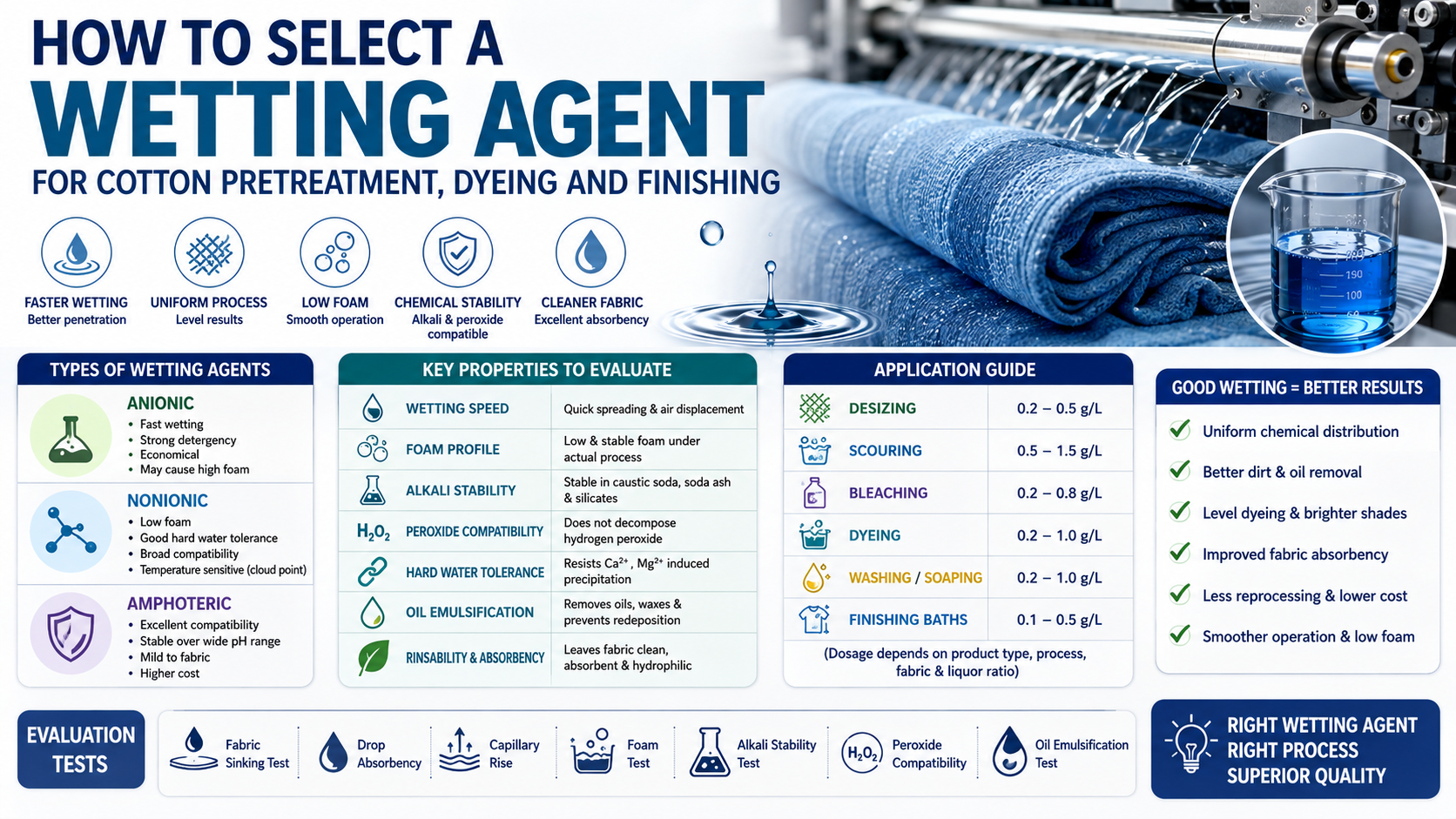
How to Select a Wetting Agent for Cotton Pretreatment, Dyeing and Finishing
Wetting agents are among the most frequently used textile auxiliaries, yet they are often selected only on the basis of price, appearance or a simple fabric-sinking test.
This approach can result in:
- Uneven pretreatment
- Incomplete desizing
- Poor scouring
- Patchy bleaching
- Unlevel dyeing
- Silicone spots
- Excessive foam
- Chemical deposits
- Poor absorbency
- Increased water consumption
- Longer processing cycles
A suitable wetting agent must do more than make a fabric sample sink quickly.
It must remain effective under the actual conditions of textile processing, which may include:
- High caustic-soda concentration
- Hydrogen peroxide
- High temperature
- Electrolytes
- Hard water
- Sequestering agents
- Oils and waxes
- Continuous mechanical agitation
- Jet-machine shear
- Low-liquor-ratio processing
- Padding pressure
- Repeated bath circulation
The correct wetting agent depends on the fibre, process stage, machine, bath chemistry and required foam profile.
A product suitable for room-temperature pad application may fail in hot alkaline scouring. A low-foam nonionic wetting agent may work well in jet dyeing but may not provide the same rapid surface activity required on a high-speed continuous range.
This guide explains how to select wetting agents for cotton pretreatment, dyeing, washing and finishing without relying only on commercial product descriptions.
What Does a Textile Wetting Agent Do?
Untreated cotton contains natural and added hydrophobic impurities such as:
- Waxes
- Pectins
- Seed-coat fragments
- Lubricants
- Knitting oils
- Spinning oils
- Sizing materials
- Dust
- Grease
- Processing contaminants
These substances resist water penetration.
When untreated fabric enters an aqueous bath, air can remain trapped between fibres and yarns. The processing liquor may spread slowly or unevenly across the fabric.
A wetting agent reduces the interfacial resistance between:
- Water and fibre
- Water and oil
- Water and air
- Processing liquor and fabric surface
This allows the bath to:
- Spread rapidly
- Displace trapped air
- Penetrate yarns and fibres
- Contact impurities
- Distribute chemicals more uniformly
Effective wetting improves the performance of:
- Desizing agents
- Caustic soda
- Hydrogen peroxide
- Enzymes
- Sequestering agents
- Dyes
- Soaping agents
- Washing chemicals
- Finishing products
A wetting agent does not perform the entire cleaning or bleaching process by itself. It enables the active chemicals to reach the textile substrate more uniformly.
Surface Tension and Dynamic Wetting
Pure water has relatively high surface tension. This limits its ability to spread quickly over hydrophobic textile surfaces.
A surfactant molecule contains:
- A water-attracting hydrophilic portion
- An oil- or surface-attracting hydrophobic portion
The molecules accumulate at interfaces and lower surface tension.
However, equilibrium surface tension alone does not completely describe wetting performance.
Textile processing often requires dynamic wetting, meaning the surfactant must migrate rapidly to a newly created interface.
This is especially important in:
- High-speed padding
- Spray application
- Continuous pretreatment
- Jet machines
- Package processing
- Short-liquor-ratio systems
- Rapid fabric immersion
Two products can have similar final surface-tension values but very different wetting speeds.
Therefore, a complete evaluation should consider:
- Initial wetting rate
- Dynamic surface activity
- Final equilibrium behaviour
- Penetration into yarn packages
- Foam generated during application
Main Categories of Textile Wetting Agents
Anionic Wetting Agents
Anionic surfactants carry a negative charge in water.
Common industrial categories include:
- Sulphonates
- Sulphates
- Phosphate esters
- Carboxylate-based surfactants
- Anionic blends
Typical Advantages
- Rapid wetting
- Strong detergency
- Good soil removal
- Effective emulsification
- Strong performance in many pretreatment applications
- Often economical
Potential Limitations
- High foam in some systems
- Sensitivity to hard-water ions
- Possible precipitation with cationic chemicals
- Compatibility problems in mixed finishing baths
- Reduced performance under certain high-electrolyte conditions
- Greater rinsing requirement in some applications
Typical Applications
- Desizing
- Scouring
- Washing
- Continuous pretreatment
- Kier boiling
- General cotton preparation
Anionic products should be checked carefully before they are used with cationic softeners, cationic fixers or cationic polymers.
Nonionic Wetting Agents
Nonionic surfactants do not carry a permanent ionic charge in water.
They commonly contain hydrophilic ethoxylate or related segments.
Typical Advantages
- Broad compatibility
- Good hard-water tolerance
- Compatibility with anionic and cationic systems
- Good oil emulsification
- Controlled foam in suitable grades
- Useful performance in alkaline media
- Suitable for blended formulations
Potential Limitations
- Cloud-point sensitivity
- Loss of solubility at elevated temperature in some grades
- Variable alkali stability
- Excess foam in highly ethoxylated grades
- Possible re-deposition if the hydrophilic-lipophilic balance is unsuitable
- Some older chemistries may not meet modern restricted-substance requirements
Typical Applications
- Jet pretreatment
- Low-foam scouring
- Dyeing
- Washing-off
- Polyester preparation
- Cotton-polyester processing
- Finishing-bath wetting
- Silicone-emulsion support
The nonionic label alone does not guarantee low foam, high-temperature stability or caustic stability.
Amphoteric Wetting Agents
Amphoteric surfactants can display different ionic characteristics depending on pH.
Typical Advantages
- Broad compatibility
- Mild behaviour
- Useful electrolyte tolerance
- Compatibility with different ionic systems
- Good stability in selected formulations
Potential Limitations
- Higher cost
- Lower wetting speed in some applications
- Performance highly dependent on molecular structure
- Not always necessary for routine pretreatment
Typical Applications
- Speciality finishing
- Sensitive blends
- Mixed ionic systems
- Formulations requiring compatibility over a broad pH range
Surfactant Blends
Many high-performance wetting agents are blends rather than single surfactants.
A blend may combine:
- Fast-wetting component
- Low-foam component
- Detergent
- Oil emulsifier
- Hydrotrope
- Solvent
- Alkali-stable surfactant
- Anti-redeposition component
- Defoaming component
The purpose is to achieve a balance between:
- Wetting speed
- Penetration
- Detergency
- Foam control
- Alkali stability
- Hard-water stability
- Temperature tolerance
A blend should be assessed as a complete product under process conditions rather than only by identifying its dominant surfactant category.
Low-Foam vs High-Foam Wetting Agents
Foam generation is one of the most important selection parameters.
Foam may be useful in certain cleaning applications, but in many modern textile machines it creates operational problems.
Problems Caused by Excessive Foam
- Pump cavitation
- Loss of liquor circulation
- Jet-machine alarms
- Fabric floating
- Rope entanglement
- Uneven chemical distribution
- Overflow
- Longer rinsing
- False liquor-level readings
- Increased antifoam consumption
- Silicone instability
- Reduced machine capacity
Where Low-Foam Wetting Is Important
- Jet dyeing machines
- Soft-flow machines
- Package dyeing
- High-speed continuous ranges
- Spray systems
- Low-liquor-ratio machines
- High-circulation washing
- Membrane-supported water reuse
Important Distinction
A product may generate low foam at room temperature but produce significant foam under:
- High shear
- Elevated temperature
- High alkalinity
- Repeated circulation
- The presence of dyes or auxiliaries
Foam must therefore be tested under realistic process conditions.
Cloud Point and Temperature Stability
Certain nonionic surfactants become less soluble when heated.
The temperature at which cloudiness or phase separation becomes visible is commonly referred to as the cloud point.
Cloud point can affect:
- Wetting
- Detergency
- Bath clarity
- Product distribution
- Oil emulsification
- Fabric deposition
- Machine deposits
A surfactant that becomes insoluble below the operating temperature may:
- Separate from the bath
- Deposit on fabric
- Lose wetting efficiency
- Create stains
- Increase oil redeposition
However, cloud-point behaviour must be interpreted in the actual bath.
The observed value may change with:
- Salt
- Caustic soda
- Surfactant concentration
- Solvent
- Hydrotrope
- Hardness
- Other auxiliaries
A cloud-point value measured only in demineralised water may not predict behaviour in a real textile bath.
Alkali Stability
Cotton scouring and bleaching can involve strongly alkaline conditions.
A wetting agent used in these processes must resist:
- High caustic concentration
- High temperature
- Electrolytes
- Long processing time
- Mechanical agitation
Poor alkali stability may cause:
- Separation
- Turbidity
- Oil release
- Precipitation
- Loss of wetting
- Fabric stains
- Machine deposits
The correct evaluation should include the actual concentration of:
- Caustic soda
- Soda ash
- Sodium silicate
- Salt
- Sequestering agent
- Hydrogen peroxide
A product that remains clear in dilute alkali may fail under concentrated pad-batch or mercerising conditions.
Hydrogen Peroxide Compatibility
Bleaching wetting agents must be compatible with hydrogen peroxide and peroxide stabilisers.
An unsuitable product may contribute to:
- Premature peroxide decomposition
- Unstable bleaching
- Pinholes
- Uneven whiteness
- Excess oxygen release
- Local fabric damage
- Poor absorbency
The complete bleach-bath compatibility should be tested using the actual:
- Hydrogen peroxide concentration
- pH
- Temperature
- Stabiliser
- Sequestering agent
- Alkali
- Water quality
The wetting agent should not introduce excessive metallic impurities or destabilising contaminants.
Hard-Water Stability
Calcium and magnesium can affect surfactant performance.
Hard water may cause:
- Precipitation
- Reduced detergency
- Soap formation
- Turbidity
- Deposits
- Poor wetting
- Uneven treatment
The risk increases when the bath also contains:
- Carbonate
- Silicate
- Fatty-acid contamination
- Anionic surfactants
- High alkalinity
For hard-water applications, evaluate the product using actual plant water rather than only laboratory demineralised water.
Monitor:
- Total hardness
- Calcium hardness
- Magnesium hardness
- Alkalinity
- Iron
- Conductivity
- Turbidity
A suitable sequestering program may be required alongside the wetting agent.
Wetting Agent for Cotton Pretreatment
Cotton pretreatment commonly includes:
- Desizing
- Scouring
- Bleaching
- Washing
- Neutralisation
- Bio-polishing in selected processes
The wetting agent should promote rapid and uniform penetration while helping remove oils, waxes and size residues.
Recommended Characteristics
- Rapid dynamic wetting
- Good detergency
- High alkali stability
- Peroxide compatibility
- Controlled foam
- Hard-water tolerance
- Good rinsability
- Low re-deposition
- Compatibility with enzymes where required
Main Evaluation Criteria
- Fabric sinking time
- Drop absorbency after treatment
- Capillary rise
- Residual oil
- Residual size
- Whiteness
- Fabric damage
- Foam
- Bath clarity
- Rewetting after drying
A fast initial sinking result does not necessarily indicate good final absorbency or impurity removal.
Wetting Agent for Continuous Bleaching
Continuous ranges require extremely rapid wetting because contact time before squeezing and steaming may be short.
The wetting agent must:
- Spread quickly
- Penetrate uniformly
- Remain stable in concentrated pad liquor
- Avoid excessive foam
- Remain compatible with peroxide
- Resist high alkalinity
- Prevent local concentration differences
Important factors include:
- Pad-liquor stability
- Fabric speed
- Wet pickup
- Squeeze pressure
- Liquor turnover
- Tank temperature
- Chemical addition sequence
For high-speed application, dynamic wetting may be more important than equilibrium wetting.
Wetting Agent for Cold Pad-Batch Processing
Cold pad-batch reactive dyeing requires uniform initial wetting and chemical distribution.
The wetting agent should:
- Provide rapid fabric penetration
- Remain stable in high alkali
- Tolerate salt
- Avoid foam
- Avoid migration
- Not interfere with dye fixation
- Prevent tailing during padding
Excess wetting-agent dosage may contribute to:
- Foaming
- Dye migration
- Shade variation
- Poor fixation
- Increased washing requirement
The minimum effective dosage should be determined through padding trials.
Wetting Agent for Reactive Dyeing
A reactive-dye bath may contain:
- Salt
- Soda ash
- Caustic soda
- Sequestering agent
- Levelling agent
- Dye
- Lubricant
- Anti-creasing agent
The wetting agent must remain compatible with the complete recipe.
Required Characteristics
- Electrolyte stability
- Low foam
- Alkali compatibility
- No dye interaction
- No shade change
- Good rinsability
- Controlled detergency
A high-detergency product may remove unfixed dye effectively during washing, but excessive surfactant during dyeing can influence exhaustion or migration.
The product should be selected specifically for either:
- Dye-bath wetting
- Washing-off
- Soaping
- Combined application
These are not automatically the same requirement.
Wetting Agent for Polyester Processing
Polyester processing may involve:
- Disperse dyes
- High-temperature dyeing
- Carriers
- Dispersing agents
- Reduction clearing
- Oligomers
- Spinning oils
- Knitting oils
The wetting agent should help emulsify oils and wet the hydrophobic polyester surface.
Required Characteristics
- High-temperature stability
- Low foam
- Good oil emulsification
- Compatibility with dispersing agents
- Resistance to oligomer deposition
- Stable performance under acidic conditions
- Good rinsing
A surfactant suitable for alkaline cotton scouring may not be ideal for acidic high-temperature polyester dyeing.
Wetting Agent for Cotton-Polyester Blends
A blended fabric contains:
- Hydrophilic cotton
- Hydrophobic polyester
- Different surface charges
- Different oil and wax contaminants
The wetting agent must provide balanced affinity for both fibres.
Recommended Direction
- Stable nonionic or blended system
- Good oil emulsification
- Controlled foam
- Broad pH stability
- Hard-water tolerance
- Compatibility with both cotton and polyester recipes
Evaluate:
- Uniform absorbency
- Oil removal
- White-ground cleanliness
- Polyester staining
- Cotton preparation
- Dyeing levelness
Wetting Agent for Yarn and Package Processing
Package dyeing requires the liquor to move through tightly wound yarn.
Poor wetting may create:
- Inner-to-outer shade variation
- Channel formation
- Air pockets
- Poor penetration
- Uneven pretreatment
- High pump pressure
The preferred wetting agent should provide:
- Rapid air displacement
- Low foam
- Excellent penetration
- Low viscosity contribution
- Good electrolyte stability
- Minimal filter blockage
A simple fabric drop test does not adequately predict package penetration.
Trials should be conducted using:
- Representative yarn
- Actual package density
- Actual flow direction
- Actual pressure
- Actual liquor ratio
Wetting Agent for Finishing Baths
Wetting agents may also be used to improve the distribution of:
- Silicone softeners
- Resins
- Water repellents
- Flame retardants
- Antistatic agents
- Optical brighteners
- Acrylic binders
The selection must account for ionic compatibility.
For example, an anionic wetting agent may destabilise a strongly cationic silicone emulsion.
The finishing-bath wetting agent should ideally provide:
- Low foam
- Broad compatibility
- Low dosage
- No interference with final properties
- No reduction in water repellency where applicable
- No silicone destabilisation
- No shade change
In finishing, excess wetting agent can be as problematic as insufficient wetting agent.
Dynamic Wetting vs Rewetting
Dynamic Wetting
Dynamic wetting measures how rapidly a fresh liquid surface spreads and penetrates.
It is important in:
- Padding
- Spray application
- Rapid immersion
- High-speed processing
Rewetting
Rewetting measures how easily a dried, treated fabric absorbs water again.
It is important for:
- Towels
- Underwear
- Cleaning cloths
- Medical textiles
- Hydrophilic finishes
- Garment comfort
A product may provide excellent initial dynamic wetting but leave a hydrophobic residue that reduces final rewetting.
Both properties should be tested where fabric absorbency is critical.
Laboratory Evaluation Methods
Fabric Sinking Test
A fabric specimen is placed on the water or test solution and the time required for complete sinking is recorded.
Advantages
- Simple
- Fast
- Useful for screening
Limitations
- Influenced by fabric construction
- Influenced by sample weight
- Does not fully represent high-temperature processing
- Does not measure detergency
- Does not predict foam
- Does not predict alkali stability
Use identical fabric dimensions, weights and conditioning for every comparison.
Drop Absorbency Test
A controlled water droplet is placed on the fabric surface and the absorption time is recorded.
This test is useful for:
- Pretreated cotton
- Towels
- Hydrophilic finishes
- Quality control
The result should be evaluated at multiple fabric positions to identify uneven treatment.
Capillary-Rise Test
A strip of fabric is suspended with one end in water, and the vertical rise over a fixed period is measured.
This provides information about:
- Wicking
- Capillary penetration
- Uniform absorbency
- Moisture transport
Draves-Type Wetting Test
A standard weighted textile skein is immersed in a surfactant solution, and the wetting time is measured.
This provides a more controlled comparison than an unstandardised fabric-sinking test.
The result is still dependent on:
- Solution concentration
- Temperature
- Water hardness
- Test material
- Weight
- Method consistency
Foam Test
Test foam under:
- Room temperature
- Operating temperature
- High shear
- Alkali
- Salt
- Actual plant water
- Repeated circulation
Record:
- Initial foam height
- Foam after fixed time
- Foam collapse
- Persistent foam
- Foam after reheating
Alkali-Stability Test
Prepare solutions containing the actual process concentrations of:
- Caustic soda
- Soda ash
- Salt
- Silicate
- Wetting agent
Observe after:
- Immediate mixing
- Heating
- Holding
- Cooling
- Overnight storage
Check for:
- Haze
- Separation
- Sediment
- Oil layer
- Viscosity change
- Loss of wetting
Peroxide-Compatibility Test
Prepare the complete bleaching recipe and monitor:
- Bath stability
- Peroxide loss
- Gas evolution
- Temperature rise
- Fabric whiteness
- Fabric strength
- Pinholes
- Deposits
Oil-Emulsification Test
Mix a known quantity of textile oil with the wetting-agent solution.
Evaluate:
- Emulsion formation
- Emulsion stability
- Oil separation
- Re-deposition on fabric
- Bath clarity after standing
A stable milky emulsion is not always sufficient. The oil must remain removable and should not redeposit during cooling or rinsing.
Suggested Product Comparison Matrix
|
Parameter |
Product A |
Product B |
Product C |
|
Wetting time |
Record |
Record |
Record |
|
Dynamic wetting |
Record |
Record |
Record |
|
Foam at room temperature |
Record |
Record |
Record |
|
Foam at process temperature |
Record |
Record |
Record |
|
Alkali stability |
Pass/fail |
Pass/fail |
Pass/fail |
|
Peroxide compatibility |
Pass/fail |
Pass/fail |
Pass/fail |
|
Hard-water stability |
Pass/fail |
Pass/fail |
Pass/fail |
|
Oil emulsification |
Record |
Record |
Record |
|
Final absorbency |
Record |
Record |
Record |
|
Whiteness |
Record |
Record |
Record |
|
Cost per kilogram fabric |
Calculate |
Calculate |
Calculate |
The preferred product should deliver the best complete process result, not only the fastest initial sinking time.
Practical Selection Matrix
|
Application |
Recommended wetting-agent direction |
Main requirement |
|
Cotton desizing |
Anionic/nonionic blend |
Wetting and size removal |
|
Cotton scouring |
Alkali-stable blended system |
Wax and oil removal |
|
Peroxide bleaching |
Peroxide-compatible low-foam system |
Uniform absorbency and whiteness |
|
Continuous bleaching |
Fast dynamic wetting agent |
Rapid penetration |
|
Cold pad-batch |
Low-foam alkali-stable system |
Uniform padding |
|
Jet pretreatment |
Low-foam nonionic/blended system |
Circulation without foam |
|
Reactive dyeing |
Electrolyte-stable low-foam system |
Level chemical distribution |
|
Reactive washing-off |
Detergent-wetting blend |
Unfixed dye removal |
|
Polyester dyeing |
Acid- and temperature-stable nonionic system |
Oil emulsification and low foam |
|
Polyester-cotton blends |
Broad-spectrum nonionic blend |
Balanced fibre wetting |
|
Yarn packages |
Low-foam penetrant |
Air displacement and package penetration |
|
Silicone finishing bath |
Compatible nonionic wetting agent |
Uniform finish without emulsion breakdown |
Dosage Selection
The optimum dosage depends on:
- Active matter
- Fabric contamination
- Liquor ratio
- Process method
- Water hardness
- Machine type
- Required wetting speed
- Surfactant blend
- Process temperature
A higher dosage is not always better.
Excess dosage can cause:
- Foam
- Longer rinsing
- Residual surfactant
- Poor dye fixation
- Finishing incompatibility
- Increased COD
- Higher treatment cost
The correct dosage is the minimum amount that produces consistent wetting and cleaning under plant conditions.
Cost Comparison
Products should be compared using process cost rather than price per kilogram.
Calculate:
Chemical cost per kilogram fabric =
Commercial dosage per kilogram fabric × Product price per kilogram
Also consider:
- Cycle-time reduction
- Water consumption
- Steam consumption
- Rinsing requirement
- Antifoam consumption
- Reprocessing
- Fabric rejection
- Whiteness
- Absorbency
- Machine cleaning
- ETP load
A higher-priced wetting agent may be more economical if it reduces processing time, foam, rinsing or rework.
Common Wetting-Agent Problems
Fabric Sinks in the Laboratory but Processes Unevenly
Possible causes:
- Test not performed under process conditions
- Poor dynamic wetting
- Insufficient oil emulsification
- Inadequate circulation
- Variable fabric contamination
- High bath hardness
- Product instability in alkali
Excessive Foam
Possible causes:
- Unsuitable surfactant structure
- High dosage
- High machine shear
- Low liquor ratio
- Carryover of detergent
- Incorrect temperature
Poor Final Absorbency
Possible causes:
- Incomplete wax removal
- Oil redeposition
- Hydrophobic surfactant residue
- Inadequate rinsing
- Silicone contamination
- Hard-water deposits
Bath Turns Turbid in Caustic
Possible causes:
- Poor alkali stability
- Reduced nonionic solubility
- Electrolyte effect
- Hard-water interaction
- Incompatible formulation
Silicone Finish Separates
Possible causes:
- Anionic wetting-agent carryover
- High residual detergent
- Hardness
- Incorrect pH
- Ionic incompatibility
- Direct mixing of concentrates
Shade Variation After Dyeing
Possible causes:
- Uneven pretreatment
- Residual oil
- Uneven absorbency
- Excess surfactant
- Product interaction with dye
- Poor rinsing
Procurement Checklist
Before approving a textile wetting agent, request or test:
- Ionic character
- Active matter
- Appearance
- pH
- Foam profile
- Dynamic wetting
- Sinking time
- Cloud point
- Alkali stability
- Peroxide compatibility
- Hard-water stability
- Electrolyte tolerance
- High-temperature stability
- Oil-emulsification performance
- Rinsability
- Restricted-substance compliance
- Storage stability
- Batch consistency
- Safety data sheet
- Technical data sheet
Do not approve a product solely because:
- It makes fabric sink quickly.
- It appears transparent.
- It produces more foam.
- It has a low price per kilogram.
- It is described as “concentrated.”
- It performs well only in demineralised water.
Frequently Asked Questions
Is a fast fabric-sinking time sufficient to select a wetting agent?
No. Sinking time is only one screening test. Alkali stability, peroxide compatibility, foam, detergency, oil emulsification, hard-water stability and final fabric absorbency must also be evaluated.
Which wetting agent is best for cotton scouring?
An alkali-stable, low- to controlled-foam system with strong wetting, wax removal and oil emulsification should be selected. Final approval requires trials under the actual scouring recipe.
Which wetting agent is best for jet machines?
A low-foam product that maintains wetting under high shear, temperature, electrolyte and repeated circulation is generally preferred.
Are nonionic wetting agents always low foaming?
No. Foam depends on molecular structure, temperature, concentration and formulation. Some nonionic surfactants can generate significant persistent foam.
What is cloud point?
Cloud point is the temperature at which certain nonionic surfactant solutions become visibly cloudy because their water solubility decreases. Actual behaviour changes in the presence of salts, alkali and other chemicals.
Can one wetting agent be used for cotton and polyester?
A broad-spectrum nonionic or blended product may work on both, but cotton and polyester have different contaminants and process conditions. Comparative trials are necessary.
Why does a wetting agent fail in hard water?
Calcium and magnesium may interact with surfactants, oils, carbonate or other bath components, causing reduced activity, precipitation or deposits.
Can wetting-agent overdose affect dyeing?
Yes. Excess surfactant can increase foam, influence dye migration, affect fixation, increase rinsing and contribute additional COD.
Why does silicone softener separate after pretreatment?
Residual anionic wetting agent or detergent can interact with cationic silicone. Inadequate rinsing, hardness and incorrect pH can increase the problem.
Should wetting agents be compared at equal dosage?
Products should first be compared at equal commercial dosage and then optimised individually. The final comparison should be based on minimum effective dosage and total process cost.
Conclusion
A textile wetting agent should not be selected only through a room-temperature fabric-sinking test.
The correct selection must consider:
- Surfactant category
- Dynamic wetting
- Foam profile
- Alkali stability
- Peroxide compatibility
- Hard-water resistance
- Temperature stability
- Oil emulsification
- Ionic compatibility
- Final fabric absorbency
- Cost per kilogram of fabric
Anionic wetting agents can provide rapid wetting and strong detergency.
Nonionic systems offer broad compatibility, oil emulsification and useful hard-water performance.
Amphoteric and blended systems can provide specialised stability and compatibility where required.
For high-speed continuous processing, rapid dynamic wetting is essential.
For jet machines, low foam under high shear is critical.
For alkaline scouring and bleaching, chemical stability is as important as initial wetting speed.
For finishing baths, compatibility with silicone, resin and other auxiliaries must be prioritised.
The best wetting agent is therefore the one that delivers uniform processing, low foam, consistent absorbency and minimum total cost under the actual production conditions.