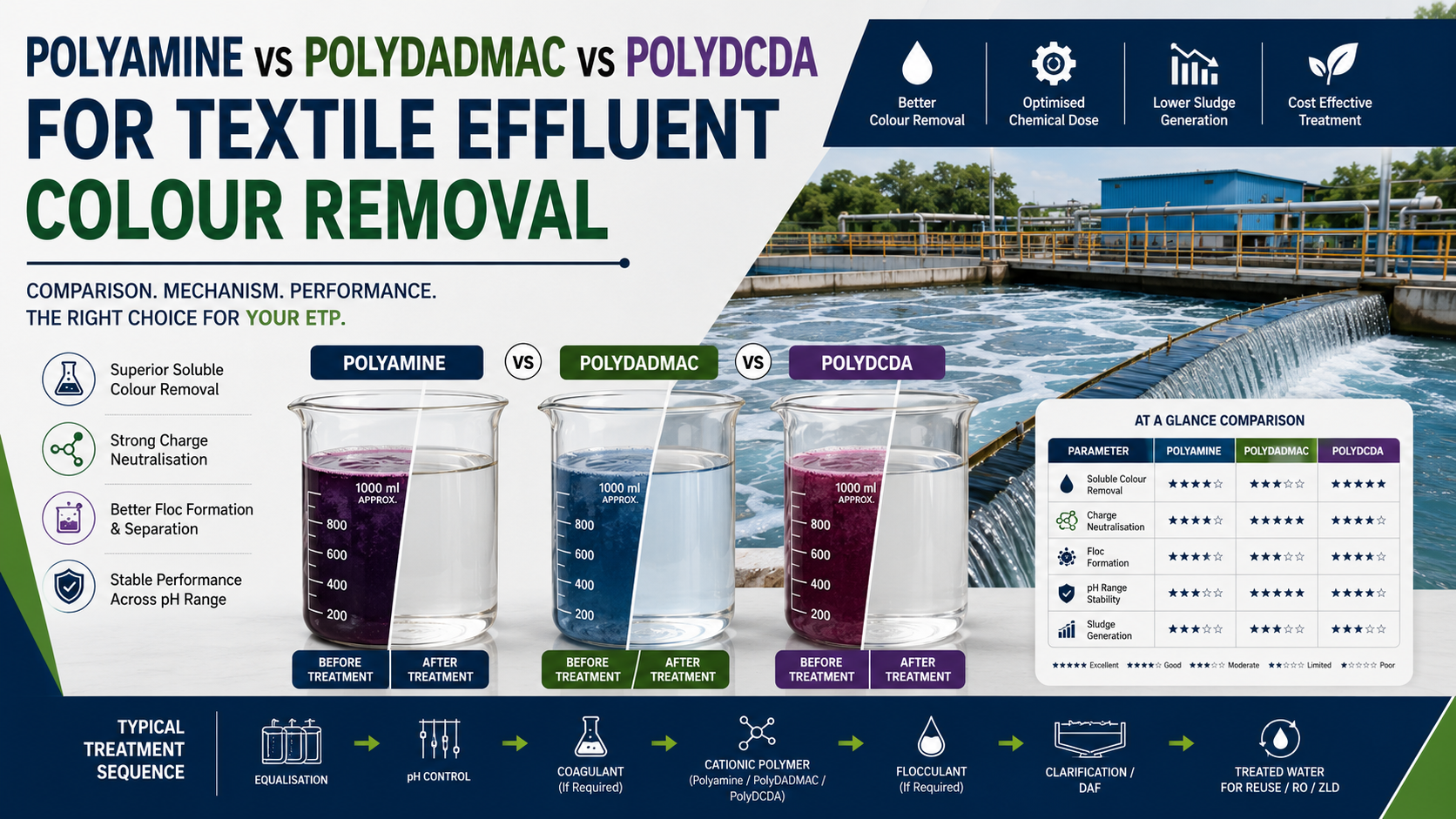
Polyamine vs PolyDADMAC vs PolyDCDA for Textile Effluent: Which Decolourant Works Best?
Colour removal is one of the most technically demanding stages of textile-effluent treatment. Even after suspended solids, turbidity, BOD and part of the COD have been reduced, treated wastewater may still retain a visible red, blue, violet, brown or black tint.
This residual colour is often caused by soluble dye molecules that remain dispersed at the molecular level. They do not settle naturally and may respond poorly to conventional inorganic coagulants when used alone.
Three cationic polymer categories are frequently considered for this application:
- Polyamine
- PolyDADMAC
- PolyDCDA
All three can interact with negatively charged contaminants, but they are not chemically identical and should not be treated as direct substitutes on a kilogram-to-kilogram basis.
Their performance can differ in terms of:
- Soluble colour removal
- Charge neutralisation
- Floc development
- Suspended-solids removal
- Sludge generation
- pH sensitivity
- Dosage requirement
- Biological compatibility
- Total treatment cost
The correct choice depends on the dye class, wastewater composition, treatment sequence and separation system. A product that performs exceptionally on reactive-dye wastewater may not provide the same result on polyester dyeing, printing or mixed finishing effluent.
This guide explains the practical differences between Polyamine, PolyDADMAC and PolyDCDA and outlines a structured method for selecting the most effective decolourisation program.
Why Textile Effluent Colour Is Difficult to Remove
Textile dyes are designed to remain stable during storage, dyeing and fabric use. Many contain complex aromatic structures and water-solubilising groups that prevent them from settling easily.
The ETP may receive colour from:
- Hydrolysed reactive dyes
- Direct dyes
- Acid dyes
- Disperse-dye particles
- Printing paste washings
- Soaping discharge
- Reduction-clearing wastewater
- Machine washing
- Floor cleaning
- Concentrated dye-bath drainage
- Finishing-chemical contamination
Reactive, direct and acid dyes commonly contain negatively charged functional groups. These groups help keep the dye soluble in water.
As a result, the colour may remain in solution even after most suspended solids have been removed.
Conventional coagulants can effectively reduce:
- Turbidity
- Fine suspended solids
- Colloids
- Printing residues
- Dispersed particles
- Some colour associated with solids
However, they may not fully remove true soluble colour. This is where cationic organic polymers become important.
The positively charged sites on these polymers interact with negatively charged dye molecules and help convert soluble colour into removable complexes or flocs.
Three Main Mechanisms of Colour Removal
Although the exact mechanism depends on polymer structure and wastewater composition, textile decolourants generally work through three principal routes.
Charge Neutralisation
Most dye molecules and colloidal contaminants in textile wastewater carry a negative surface charge.
This charge creates repulsion between particles and keeps them dispersed.
A cationic polymer neutralises part of this negative charge, reducing electrostatic repulsion and allowing contaminants to aggregate.
Dye–Polymer Complex Formation
The polymer can bind with soluble dye molecules and form a larger complex.
This complex may become:
- Less soluble
- Less stable
- Easier to settle
- Easier to float in DAF
- Easier to capture through filtration
This mechanism is particularly important for reactive and direct dyes.
Polymer Bridging
A sufficiently long polymer chain can attach to multiple particles or dye complexes simultaneously.
This forms larger and stronger flocs that separate more rapidly.
Not every high-charge polymer is a strong bridging polymer. Molecular weight, chain length and polymer structure significantly influence floc development.
What Is Polyamine?
Polyamine is a broad industrial term used for cationic polymers containing amine or quaternary ammonium functionality.
In wastewater treatment, many commercial polyamines are condensation polymers produced using amine-based raw materials. Their exact composition can vary considerably between manufacturers and grades.
Polyamine products may differ in:
- Active solids
- Molecular weight
- Charge density
- Degree of branching
- Viscosity
- pH
- Polymer-chain length
- Residual raw materials
- Colour-removal strength
Therefore, two materials labelled as polyamine should not automatically be assumed to be technically equivalent.
How Polyamine Works
Polyamine generally combines:
- Charge neutralisation
- Adsorption
- Dye complexation
- Limited or moderate polymer bridging
Its positively charged sites interact with anionic dye molecules, surfactants and colloidal organic contaminants.
Depending on its molecular structure, it may provide a useful balance between soluble-colour removal and floc development.
Where Polyamine Commonly Performs Well
Polyamine can be effective in wastewater containing:
- Reactive dyes
- Direct dyes
- Mixed dye classes
- Printing residues
- Organic colloids
- Soaping-agent residues
- Dispersants
- Mixed dyeing and finishing discharge
It is often useful where the effluent contains both soluble colour and colloidal organic matter.
Advantages of Polyamine
Balanced Treatment Performance
Polyamine can provide both colour neutralisation and some floc-building ability.
Strong Interaction with Anionic Colour
It can perform well against negatively charged reactive and direct dyes.
Lower Inorganic Sludge
Unlike aluminium- or iron-based coagulants, it does not form large quantities of metal-hydroxide precipitate.
Limited pH Depression
It generally causes less pH reduction than alum or acidic inorganic coagulants.
Compatibility with Clarification and DAF
Correctly conditioned flocs can be separated through:
- Clarifiers
- Tube settlers
- Lamella settlers
- DAF systems
Potential Reduction in Inorganic-Coagulant Consumption
In suitable effluent, polyamine may allow lower dosing of PAC, alum or ferric salts.
Limitations of Polyamine
Polyamine may not be sufficient by itself when wastewater contains:
- Very high suspended solids
- High printing-paste residues
- Heavy oil and grease
- Stable silicone emulsions
- High concentrations of insoluble matter
- Significant metallic or mineral solids
In such cases, a primary inorganic coagulant or a specialised blended treatment may still be required.
Polyamine performance can also deteriorate because of:
- Incorrect dosing order
- Poor mixing
- Overdosing
- Under-dosing
- Inadequate flocculation time
- High variation in inlet colour
- Uncontrolled pH
- High anionic surfactant load
What Is PolyDADMAC?
PolyDADMAC is the commonly used abbreviation for poly(diallyldimethylammonium chloride).
It is a water-soluble cationic polymer containing permanent quaternary ammonium groups.
Because the positive charge is built into its chemical structure, PolyDADMAC generally remains strongly cationic across a broad pH range.
Commercial grades can vary in:
- Molecular weight
- Active concentration
- Viscosity
- Polymer-chain length
- Residual monomer
- Charge density
- Application strength
PolyDADMAC is commonly used as a charge-neutralising coagulant rather than as a conventional high-molecular-weight flocculant.
How PolyDADMAC Works
Its primary mechanism is strong charge neutralisation.
It rapidly reduces the negative charge carried by:
- Fine suspended particles
- Colloids
- Anionic surfactants
- Dye molecules
- Organic contaminants
This destabilisation produces small aggregates or microflocs.
Because these microflocs may remain relatively small, PolyDADMAC is frequently used with a separate high-molecular-weight flocculant to improve settling or flotation.
Where PolyDADMAC Commonly Performs Well
PolyDADMAC can be effective in effluent containing:
- High colloidal load
- Fine suspended solids
- Anionic charge demand
- Moderate colour
- Disperse-dye particles
- Printing residues
- Turbidity
- Emulsified contaminants
It may be particularly useful where the treatment challenge is not only soluble colour but also fine, negatively charged colloidal matter.
Advantages of PolyDADMAC
High Cationic Charge Density
It can neutralise anionic contaminants rapidly.
Broad Working pH Range
Its permanent positive charge gives relatively stable performance across different pH conditions.
Strong Coagulation Performance
It is effective in destabilising fine colloids and suspended contaminants.
Low Inorganic-Sludge Contribution
It does not form the same metal-hydroxide sludge generated by aluminium or iron salts.
Fast Reaction
Charge neutralisation can occur quickly when mixing is adequate.
Compatibility with Anionic Flocculants
After charge neutralisation, a suitable anionic flocculant can often create larger and stronger flocs.
Limitations of PolyDADMAC
PolyDADMAC may not always provide the strongest soluble-colour removal where wastewater contains a high concentration of hydrolysed reactive dye.
Its performance can be limited when:
- Soluble dye concentration is extremely high
- Colour bodies require stronger complexation
- Molecular weight is too low for effective separation
- The wastewater contains a high load of competing anionic chemicals
- The polymer is consumed by surfactants before reacting with the dye
- No secondary flocculant is used
- The polymer is overdosed
Because PolyDADMAC has high charge density, overdose can lead to charge reversal.
Instead of improving separation, excessive dosing may:
- Restabilise particles
- Produce weak flocs
- Increase residual cationic charge
- Cause downstream process disturbance
What Is PolyDCDA?
PolyDCDA is an industrial term commonly used for cationic decolourant polymers based on dicyandiamide condensation chemistry.
Many commercial grades are associated with dicyandiamide-formaldehyde polymer systems, although exact formulations, modifiers and polymerisation routes can differ.
PolyDCDA products may vary in:
- Molecular weight
- Active concentration
- Cationic strength
- Viscosity
- Degree of polymerisation
- Residual raw materials
- Free formaldehyde
- Ammonium-salt content
- Storage stability
- Colour-removal efficiency
This variability is important. A low-cost product with weak polymerisation or low active content may require a much higher dose than a properly engineered grade.
How PolyDCDA Works
PolyDCDA is particularly associated with soluble-dye colour removal.
Its cationic functional groups interact with negatively charged dye molecules and form dye–polymer complexes.
The principal mechanisms include:
- Charge neutralisation
- Strong dye complexation
- Adsorption
- Reduction in dye solubility
- Formation of separable aggregates
The resulting colour-containing complexes are removed through:
- Settling
- DAF
- Tube settlers
- Clarification
- Filtration
A separate flocculant may be required to enlarge the flocs and accelerate separation.
Where PolyDCDA Commonly Performs Well
PolyDCDA can be effective in wastewater containing:
- Reactive dyes
- Direct dyes
- Acid dyes
- Dark-shade dyeing discharge
- Printing wash water
- Soaping discharge
- Dye-manufacturing wastewater
- Highly soluble anionic colour
It is often evaluated where PAC, alum or general-purpose coagulants remove turbidity but leave a strongly coloured supernatant.
Advantages of PolyDCDA
Strong Soluble-Colour Removal
It is specifically associated with the removal of difficult, water-soluble textile dyes.
Rapid Visual Decolourisation
A suitable grade can produce a visible improvement within a short reaction time.
Lower Inorganic Sludge
It may reduce dependence on heavy metal-salt dosing.
Limited pH Reduction
It generally has less direct effect on pH than acidic inorganic coagulants.
Strong Performance on Reactive Dyes
It frequently performs well where hydrolysed reactive dyes dominate the wastewater.
Potentially Low Treatment Dosage
A high-quality product may perform at a comparatively low dosage, although this depends on colour load and active concentration.
Limitations of PolyDCDA
PolyDCDA may not be the best standalone solution when the wastewater contains:
- Very high suspended solids
- Heavy printing-paste residues
- Large quantities of mineral matter
- Oil and grease
- Stable silicone emulsions
- Large disperse-dye particles
- Poorly equalised shock loads
It can also produce small or fragile colour complexes that require a separate flocculant for proper separation.
Other possible limitations include:
- Overdose sensitivity
- Variation between commercial grades
- Residual formaldehyde concerns in poorly controlled products
- Polymer carryover
- Increased organic load if overdosed
- Weak sludge dewaterability in some applications
Polyamine vs PolyDADMAC vs PolyDCDA: Practical Comparison
|
Parameter |
Polyamine |
PolyDADMAC |
PolyDCDA |
|
Polymer category |
Cationic amine-based polymer |
Quaternary ammonium polymer |
Dicyandiamide-based cationic polymer |
|
Principal strength |
Balanced colour and organic-colloid removal |
Strong charge neutralisation |
Strong soluble-dye decolourisation |
|
Reactive-dye colour removal |
Good to very good |
Moderate to good |
Frequently very good |
|
Direct-dye colour removal |
Good |
Moderate to good |
Very good |
|
Fine-colloid removal |
Good |
Very good |
Moderate |
|
Turbidity reduction |
Good |
Very good |
Moderate to good |
|
Suspended-solids removal alone |
Moderate |
Good |
Moderate |
|
Floc size |
Grade-dependent |
Often small without flocculant |
Grade-dependent |
|
Need for secondary flocculant |
Often beneficial |
Frequently required |
Often beneficial |
|
Inorganic sludge contribution |
Low |
Low |
Low |
|
Effect on pH |
Generally limited |
Generally limited |
Generally limited |
|
Overdose sensitivity |
High |
High |
High |
|
Main application advantage |
Mixed wastewater |
Charge and colloid control |
Difficult soluble colour |
This comparison represents general industrial behaviour. Actual treatment performance must be confirmed on representative wastewater.
Which Polymer Is Best for Reactive-Dye Wastewater?
Reactive dyeing wastewater commonly contains:
- Hydrolysed reactive dye
- Sodium chloride or sodium sulphate
- Soda ash
- Caustic soda
- Sequestering agents
- Wetting agents
- Soaping agents
- Dispersants
- High alkalinity
Because hydrolysed reactive dyes remain soluble and anionic, PolyDCDA often performs strongly in this application.
However, Polyamine may perform equally well or better when the effluent also contains:
- Printing residues
- Surfactants
- Organic colloids
- Multiple dye classes
- Mixed process discharge
PolyDADMAC may be preferred when fine colloids, turbidity and high anionic charge demand are significant alongside colour.
The correct selection must be made through a controlled comparative jar test.
Which Polymer Is Best for Polyester Dyeing Wastewater?
Polyester dyeing wastewater usually contains disperse dyes rather than highly water-soluble reactive dyes.
It may also contain:
- Dispersing agents
- Levelling agents
- Acetic acid
- Reduction-clearing chemicals
- Caustic residues
- Oligomers
- Oil and grease
- Finishing-chemical contamination
In this type of wastewater, colloid destabilisation may be as important as soluble-colour complexation.
PolyDADMAC or Polyamine may therefore perform well because they can destabilise fine suspended and dispersed contaminants.
PolyDCDA may still reduce visible colour, but it should not be selected automatically unless the colour is demonstrated to be predominantly soluble and anionic.
Which Polymer Is Best for Printing Wastewater?
Printing wastewater can contain:
- Reactive dyes
- Pigments
- Binders
- Thickeners
- Urea
- Acrylic residues
- Surfactants
- Screen-washing contaminants
This is a mixed wastewater challenge.
Polyamine may provide a useful balance between:
- Colour removal
- Organic-colloid neutralisation
- Polymer bridging
PolyDADMAC may improve coagulation where fine pigment, binder or thickener residues dominate.
PolyDCDA may provide strong decolourisation where soluble reactive-dye colour is the principal issue.
A combination treatment may be more effective than a single polymer.
Importance of Active Content
Commercial polymer products should not be compared only by liquid dosage.
For example, two products may be dosed at 100 ppm, but one may contain:
- 20% active polymer
while another contains:
- 50% active polymer
Their actual active-polymer dosages are therefore different.
The correct comparison should consider:
Active polymer dosage =
Commercial dosage × Active-solids fraction
Example:
Commercial dosage: 100 mg/L
Active solids: 40%
Active polymer dosage:
100 × 0.40 = 40 mg/L
A lower-priced, highly diluted product may be more expensive in actual use.
Why Price per Kilogram Is Misleading
The correct economic measure is treatment cost per kilolitre.
Example:
Product A
Commercial dosage: 80 mg/L
Price: ₹100/kg
Treatment cost:
0.08 kg/KL × ₹100/kg = ₹8/KL
Product B
Commercial dosage: 250 mg/L
Price: ₹50/kg
Treatment cost:
0.25 kg/KL × ₹50/kg = ₹12.50/KL
Although Product A costs twice as much per kilogram, it gives a lower treatment cost.
A complete comparison should include:
- Decolourant cost
- Coagulant cost
- Flocculant cost
- Acid or alkali requirement
- Sludge volume
- Filter-press operation
- Sludge disposal
- Activated-carbon consumption
- RO-cleaning frequency
- Plant downtime
- Outlet consistency
Recommended Jar-Test Method
A controlled jar test is essential before selecting any of the three polymer categories.
Step 1: Collect a Representative Sample
Collect wastewater from a properly mixed equalisation tank.
Do not rely only on:
- A single machine drain
- A concentrated first wash
- The surface of the equalisation tank
- Settled bottom sludge
- A one-time dark-shade discharge
Record:
- pH
- Temperature
- Colour
- COD
- TSS
- Turbidity
- Conductivity
- Dye class
- Shade running
- Production process
Step 2: Prepare Standardised Solutions
Prepare all polymer samples at the same known concentration where possible.
This ensures accurate comparison.
Record:
- Product weight
- Dilution-water quantity
- Solution concentration
- Preparation time
- Mixing time
- Solution age
Step 3: Test the Blank
Keep one untreated beaker as the reference.
This helps compare:
- Original colour
- Natural settling
- Turbidity
- Sludge formation
- pH changes
Step 4: Screen the Three Polymer Categories
Prepare separate beakers for:
- Polyamine
- PolyDADMAC
- PolyDCDA
Test multiple dosages of each.
For example:
- Low dose
- Medium dose
- High dose
- Very high dose only for overdose observation
The dosage range should be selected according to colour intensity and product active content.
Step 5: Standardise Mixing
Use the same mixing procedure for every beaker.
A practical sequence may include:
- Rapid mixing after polymer addition
- Controlled reaction time
- Addition of flocculant, where required
- Slow mixing for floc growth
- Settling without disturbance
Mixing conditions should remain identical so that only chemical performance changes.
Step 6: Evaluate pH
The best-performing dosage should be repeated at different pH values.
Possible screening levels may include:
- Original pH
- pH 6.0
- pH 6.5
- pH 7.0
- pH 7.5
- pH 8.0
This range is only a testing framework. The optimum pH depends on the actual wastewater and polymer grade.
Step 7: Compare the Complete Result
Evaluate:
- Residual colour
- Supernatant clarity
- Floc size
- Floc strength
- Settling speed
- Floating matter
- Sludge volume
- Sludge compactness
- Final pH
- COD reduction
- Turbidity
- Treatment cost per KL
The clearest beaker is not automatically the best treatment program.
A slightly less clear sample may be commercially superior if it provides:
- Better sludge dewatering
- Lower dosage
- Faster separation
- Lower residual polymer
- Better biological compatibility
Role of the Secondary Flocculant
Colour complexation and floc development are separate treatment stages.
A cationic decolourant may neutralise the dye effectively but produce small flocs.
A suitable flocculant can then bridge these complexes and improve:
- Floc size
- Settling speed
- DAF flotation
- Clarifier performance
- Sludge dewatering
The flocculant may be:
- Anionic
- Cationic
- Non-ionic
Its selection depends on the residual charge after decolourant dosing.
After a high-cationic decolourant dose, an anionic flocculant often performs well, but this must be verified experimentally.
Common Reasons for Treatment Failure
Incorrect Polymer Selection
A high-charge coagulant may be selected when the actual problem is soluble dye complexation.
Excessive Dosage
Overdosing can create charge reversal and restabilisation.
Insufficient Dosage
The available cationic sites may be inadequate for the dye load.
Poor Equalisation
Sudden shade changes make a fixed dosage unreliable.
Incorrect Mixing
Poor distribution reduces dye–polymer contact.
Wrong Dosing Point
The polymer may react with another chemical before reaching the dye.
High Surfactant Load
Anionic surfactants can consume cationic polymer.
Inadequate Flocculation
Good colour neutralisation may not translate into effective separation.
Clarifier or DAF Overloading
Correct chemistry cannot compensate for poor hydraulic separation.
Uncalibrated Dosing Pumps
The displayed dosing setting may not match the actual delivered quantity.
Effect on Sludge Generation
Polyamine, PolyDADMAC and PolyDCDA generally contribute less inorganic sludge than aluminium- or iron-based coagulants.
However, they do not eliminate sludge.
The removed material still becomes part of the separated solids, including:
- Dye molecules
- Organic contaminants
- Suspended solids
- Polymer complexes
- Printing residues
The ideal program should produce:
- Low sludge volume
- Compact sludge
- Rapid settling
- Good dewaterability
- Low chemical carryover
A low sludge volume with poor colour removal is not an acceptable result.
Effect on COD
Colour and COD are related but not identical.
A cationic polymer may reduce COD when coloured organic molecules are transferred from water into sludge.
However:
- Not all COD comes from dyes.
- Surfactants may remain.
- Dispersing agents may remain.
- Soluble auxiliaries may remain.
- Excess polymer can contribute organic load.
Therefore, both colour and COD should be tested.
A visually clear sample may still contain significant dissolved organic matter.
Effect on Biological Treatment
Residual cationic polymers can interact with biological sludge.
Excess carryover may affect:
- Biomass floc structure
- Sludge settling
- Extracellular polymeric substances
- Fine suspended biomass
- Oxygen transfer
- Membrane fouling in MBR systems
The selected program should remove colour effectively while minimising residual polymer entering the biological stage.
Effect on RO and ZLD
Good colour removal can reduce:
- Organic fouling
- Activated-carbon loading
- UF fouling
- RO membrane contamination
- Colour concentration in reject streams
- MEE condensate-quality risk
However, none of these polymers directly removes:
- Sodium chloride
- Sodium sulphate
- Hardness
- Silica
- Alkalinity
- Dissolved inorganic salts
The decolourant program must therefore remain part of a broader RO and ZLD pretreatment strategy.
Which Polymer Should Be Selected?
Select Polyamine When:
- Wastewater contains mixed dye classes.
- Colour and organic colloids are both important.
- Printing and dyeing streams are combined.
- Moderate bridging is beneficial.
- Clarification or DAF is available.
Select PolyDADMAC When:
- Anionic charge demand is high.
- Fine colloids and turbidity dominate.
- Rapid destabilisation is required.
- Suspended matter is significant.
- A secondary flocculant can be used.
Select PolyDCDA When:
- Soluble reactive-dye colour dominates.
- Dark shades produce persistent coloured supernatant.
- Conventional coagulation removes solids but leaves colour.
- Dye complexation is the principal treatment objective.
These are selection guidelines, not universal rules.
Frequently Asked Questions
Is PolyDCDA the same as Polyamine?
No. Polyamine is a broader category of amine-based cationic polymers. PolyDCDA generally refers to dicyandiamide-based decolourant polymers. Both are cationic, but their chemical structures and performance can differ.
Is PolyDADMAC a decolourant?
PolyDADMAC can remove colour in suitable wastewater, but its principal strength is high-charge coagulation and colloid destabilisation. It may not always provide the strongest removal of highly soluble reactive-dye colour.
Which polymer works best for reactive dyes?
PolyDCDA frequently performs strongly on soluble reactive-dye colour. However, Polyamine may perform better in mixed wastewater containing surfactants, printing residues and organic colloids.
Can one polymer remove all textile colour?
No. Textile effluent changes with dye class, shade, pH, salt, process chemicals and production sequence. The optimum polymer may change with the wastewater composition.
Is a higher dosage always better?
No. Excess cationic-polymer dosage can cause charge reversal, weak flocculation, residual polymer and increased operating cost.
Why is a secondary flocculant required?
The decolourant may neutralise or complex the dye but produce small aggregates. A high-molecular-weight flocculant helps create larger, stronger and faster-separating flocs.
Can these polymers replace PAC completely?
In some wastewater, the organic-polymer program may significantly reduce PAC demand. However, PAC or another inorganic coagulant may still be required when suspended solids, printing residues and colloidal matter are high.
Why does the laboratory result differ from plant performance?
Common causes include poor equalisation, incorrect dilution, uncalibrated dosing pumps, inadequate mixing, hydraulic overloading and changing wastewater composition.
Should products be compared by price per kilogram?
No. They should be compared by cost per kilolitre at equivalent outlet quality, including sludge, pH correction, flocculant consumption and downstream operating impact.
Conclusion
Polyamine, PolyDADMAC and PolyDCDA are all cationic polymers, but they are designed to address different treatment challenges.
Polyamine generally provides a balance of:
- Colour neutralisation
- Adsorption
- Organic-colloid treatment
- Moderate bridging
PolyDADMAC is particularly strong in:
- Charge neutralisation
- Colloid destabilisation
- Turbidity reduction
- Rapid coagulation
PolyDCDA is especially associated with:
- Soluble dye complexation
- Reactive-dye colour removal
- Direct- and acid-dye decolourisation
- Persistent residual-colour control
The most effective polymer cannot be selected from its chemical name alone.
A complete technical comparison must consider:
- Active solids
- Actual dosage
- Residual colour
- Floc quality
- Sludge volume
- Separation performance
- COD impact
- Biological compatibility
- RO compatibility
- Total treatment cost per kilolitre
The correct procurement strategy is therefore not to purchase the cheapest polymer. It is to select the treatment program that delivers consistent outlet quality at the lowest sustainable overall operating cost.
A comparative jar test using representative equalised wastewater should always be completed before implementing any Polyamine, PolyDADMAC or PolyDCDA program at plant scale.